
Wound Care Certification for RN: Requirements, Costs, and Options
Wound Care Certification for RN: Requirements, Costs, and Options
Wound care has become one of the fastest-growing specialties in modern healthcare—and its demand is evident. More specifically, chronic wounds, pressure injuries, diabetic foot ulcers, and complex wound cases have become significantly more common. As a result, healthcare facilities are placing greater value on registered nurses with wound care certifications.
As we discussed in our guide, “How Do You Become a Certified Wound Care Nurse?”, wound care certification offers considerable benefits. To begin, it enables registered nurses to increase their clinical knowledge, develop specialized assessment and treatment skills, and pursue advanced career opportunities. Beyond career advancement, specialized wound care education is a vital step in improving patient outcomes through evidence-based care.
To help you pursue this journey, we’re discussing the most common wound care certifications for registered nurses. We’ll explore how long each certification program generally takes, eligibility requirements, and what to expect throughout the process. Understanding how certification can support your clinical growth is the first step in navigating your options.
Royal Wound Care, proudly serving the greater San Fernando Valley, is committed to supporting the professional growth of nurses and other healthcare providers through education and collaboration. Review our advanced educational pathways and partnership opportunities to learn more.
Wound Care Certification for RN: Requirements, Costs, and Options
Wound care has advanced far beyond treating lacerations and prescribing antibiotic ointments. Today’s wound care nurses are responsible for wound assessment, treatment planning, pressure injury prevention, debridement decisions, patient education, and interdisciplinary collaboration.
Additionally, registered RNs commonly work alongside physical therapists, surgeons, physicians, vascular specialists, and other healthcare professionals to coordinate treatment plans for comprehensive care. Due to the industry’s scope, evidence-based techniques, continuing education, and certification pathways remain extremely important.
However, several certifications are available for registered nurses, making it challenging to choose the right one. Evaluating each option carefully before beginning is the first and most important step, as the best pathway depends on a nurse’s clinical experience and long-term career goals.
Before discussing your options, here is why wound care certification is a worthwhile investment for registered nurses:
Is Wound Care Certification Worth It for RNs?
Wound care certification is absolutely worth pursuing for registered nurses (RNs), and there are many reasons why.
First, certification provides value through specialization, credibility, and career advancement opportunities. More specifically, research shows that on average, RNs report an increase of roughly $10,000 after achieving certification. Following this, given their experience, many RNs transition into more specialized clinical roles, such as wound program manager or mobile wound care nurse. (Learn more in our guide, “Mobile Wound Care for Skilled Nursing Facilities in Los Angeles!”)
Beyond professional growth, a wound care-certified nurse often possesses specialized knowledge to support patients at every stage of recovery. For example, they can actively apply evidence-based protocols, create personalized treatment plans, and monitor patients throughout the healing process. Not only does this support better patient trust, but it also makes an RN a vital asset to healthcare facilities.
Both professionally and personally, wound care certification can help nurses stand out in a competitive market while expanding their knowledge to make a significant difference in patients’ lives.
Interested in learning more about the possibilities in the wound care industry? Visit our comprehensive guide, “Difference Between Wound Care Certificate-Trained and Board-Certified Providers.”
Which Wound Care Certification Is Best for RNs?
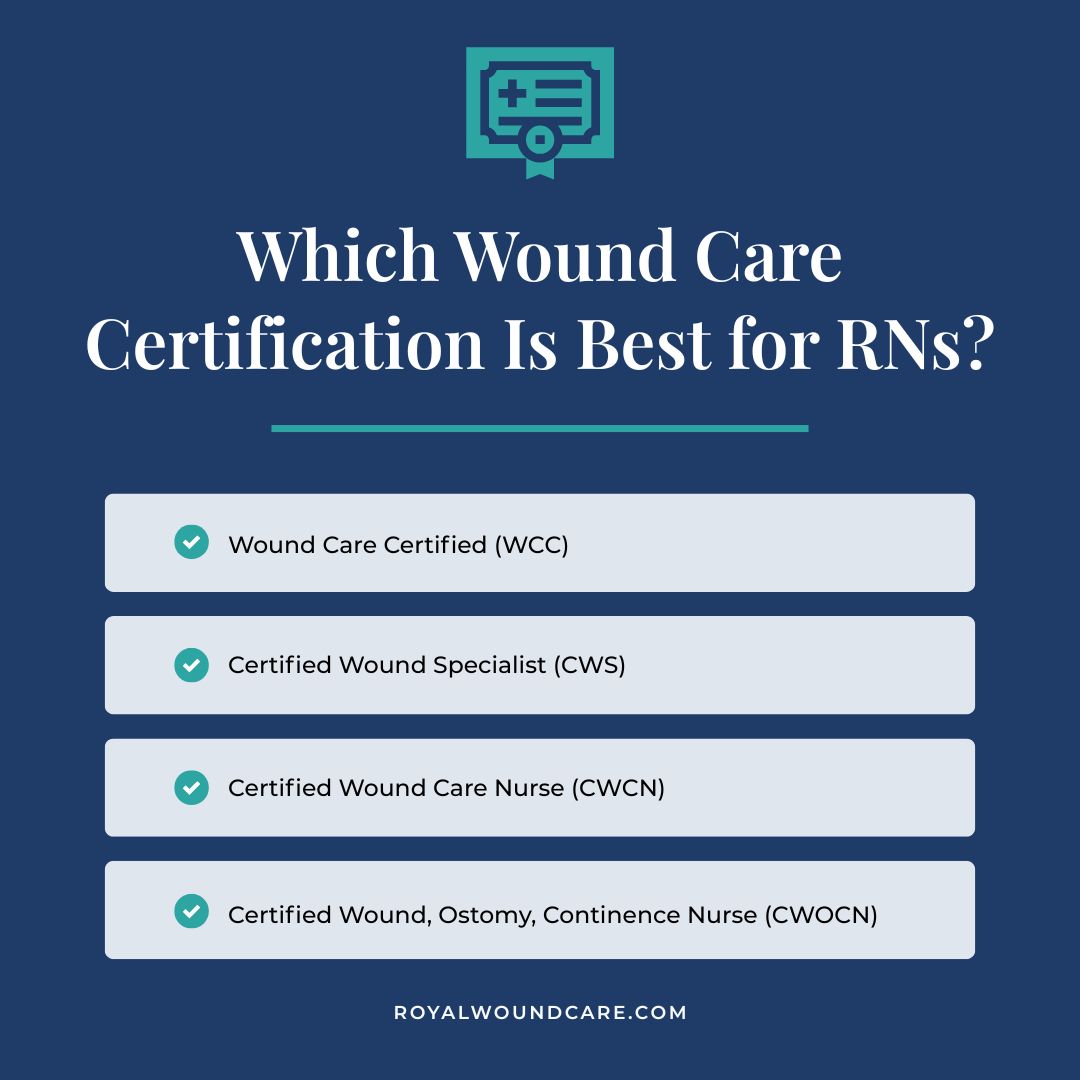
There is no universal “best” wound care certification for every nurse. Ultimately, the ideal choice depends on clinical background, career objectives, and preferred patient population. However, the wound care certifications we provide below are often some of the top-recognized and recommended within the field:
Wound Care Nurse Certification (WCN-C)
The Wound Care Nurse Certification (WCN-C) is a premier national training program designed to meet the basic educational needs of nurses working across a variety of healthcare settings. More specifically, this course offers a comprehensive review of what licensed and registered nurses can expect working in wound care.
Within the education program, nurses can expect to learn more about:
Anatomy and physiology of the skin
Phases of wound healing
Fundamentals of wound care
Classification of wounds
Wound care dressing uses and properties
Types of and uses for wound debridement
Role of a wound care nurse
Additionally, nurses will participate in a skills lab which covers Negative Pressure Wound Therapy (NPWT) dressing, wound culture technique, compression therapy, aseptic dressing change techniques, and more.
Offered exclusively by Royal Wound Care and approved by both the California Board of Registered Nursing and the California Board of Vocational Nursing, the WCN-C is designed to prepare healthcare professionals to perform at the highest level of care across all settings.
Wound Care Certified (WCC)
The Wound Care Certified (WCC) credential is one of the most widely recognized and versatile designations within the industry. Administered through the National Alliance of Wound Care and Ostomy (NAWCO), the WCC credential focuses primarily on wound assessment, treatment principles, and evidence-based wound management.
In certification, nurses will learn how to:
Evaluate wound etiologies
Stage pressure injuries
Recognize signs of infection
Select appropriate dressings
Manage complex wounds
Implement pressure injury prevention protocols
For many RNs, the WCC credential offers a relatively accessible entry point into the wound care specialization. While still providing valuable professional recognition, it’s highly inclusive and helps build a strong foundation before pursuing more advanced certifications.
Certified Wound Specialist (CWS)
The Certified Wound Specialist (CWS) credential, issued by the American Board of Wound Management (ABWM), is a nationally accredited certification. As one of the most advanced credentials available, CWS certification is often pursued by nurses with significant wound care experience and extensive educational backgrounds.
During CWS certification, nurses learn more about:
Interpreting vital signs
Evaluating circulatory and musculoskeletal systems
Identifying factors that can delay healing
Best practices in infection
Pressure ulcer prevention strategies
Advanced treatment methods
Selecting the correct dressings
Addressing systemic factors
Because of its rigorous eligibility requirements, the CWS credential is widely considered the gold standard for wound management. The exam tests cross-disciplinary knowledge, demonstrating that nurses meet the highest standards of wound care competence in the industry.
Certified Wound Care Nurse (CWCN)
The Certified Wound Care Nurse (CWCN) credential provides advanced training in preventing, managing, and healing acute and chronic wounds. Provided by the Wound, Ostomy, and Continence Nursing Certification Board (WOCNCB), this credential is designed specifically for RNs specializing in wound care nursing practice.
During certification, registered nurses learn more about:
Evaluating wound depth and size
Underlying causes of wounds
Applying advanced dressings
Performing debridement
Managing Negative Pressure Wound Therapy
Reducing the risk of pressure ulcers
Educating patients and caregivers about wound care
In many cases, registered nurses pursue the CWCN credential to accelerate career development and professional credibility. Having this foundational knowledge is essential in meeting strict compliance requirements while also improving long-term care outcomes.
Certified Wound, Ostomy, Continence Nurse (CWOCN)
The Certified Wound, Ostomy, and Continence Nurse (CWOCN) credential is a tri-specialty credential offered through the Wound, Ostomy, and Continence Nursing Certification Board (WOCNCB). More specifically, this certification covers three specialty areas: wounds, stoma/ostomy management, and continence complications.
Within certification, registered nurses learn more about:
Pressure injury prevention
Ulcer assessment
Advanced therapy application
Stoma assessment
Appliance fitting
Complication management
Incontinence protocols
Bladder and bowel training
Catherization
Product selection
For registered nurses, this credential actively prepares them to transition into specialized clinical roles. More specifically, research shows patients cared for by WOCN-certified nurses experienced 40% faster healing times. This is an excellent certification for increasing earning potential, advancing in your career, and enhancing professional credibility.
How Long Does It Take to Get Wound Care Certification for RNs?
Ultimately, there is no definitive timeline for completing wound care certification programs. Timeframes vary considerably depending on the credential, experience level, and whether additional wound care education or clinical hours are required. However, for an average estimate, this is what you can expect:
WCN-C Certification Timeline
The WCN-C certification is an 8-hour program that nurses can take online or in person. (Online attendees must complete hands-on skills competency with a qualified preceptor.) As one of the faster pathways, this credential is a one-day virtual or live-session workshop involving lectures, interactive learning, and visual skill demonstrations. Many candidates complete the course accordingly, within one day.
Related: Wound Care Certification For LPN: Requirements and Career Path
WCC Certification Timeline
The WCC credential is often one of the faster pathways compared to similar certification courses. On average, most candidates complete credentialing within 1–3 months. However, this process is broken in sections.
Educational Requirements: Online, self-paced courses can require 23–40 hours of study time, with providers allowing up to 6 months for completion. In-person or live online bootcamps, however, generally feature 4 days of seminars.
Clinical Experience: RNs have two options. First, they must either complete 120 contact hours directly related to wound care, which can take approximately 2–3 weeks. Second, they can provide documentation of 2 years of full-time or 4 years of part-time experience within wound care.
Application and Certification Exam: Submitting transcripts, receiving application approval, and taking the exam generally takes 1–2 weeks.
In most cases, completing the WCC credentialing process takes just a few months. However, for those balancing other commitments, the timeline may be slightly longer.
Related: Wound Care Training for Nurses: Courses and Certifications
CWS Certification Timeline
The CWS credential typically requires more preparation due to its more stringent eligibility criteria. More specifically, most candidates complete the course within 3–36 months. The timeline often looks like:
Educational Requirements: Active, unrestricted nurses must have 3 years of cumulative clinical experience in wound management. If you have 0–2 years of experience, you can register as a CWS candidate, which grants you up to 3 years to accumulate the required clinical hours.
Application and Approval: After applying for credentialing through the ABWM Application Portal, the organization will review your application and notify you of your status within 3-5 business days. On average, this entire phase can take 2–6 weeks.
Exam Preparation: After receiving approval, you have a 90-day eligibility period to schedule and take your exam. Many nurses dedicate several weeks to studying, resulting in an average 1–3 months timeline.
Testing and Certification: The proctored, computer-based test will take approximately 2 hours. Because it’s computer-based, you generally receive results immediately.
The average timeline for CWS credentialing ultimately depends on experience, educational background, and whether candidates already meet the certification’s eligibility requirements.
CWCN Certification Timeline
The CWS credentialing process generally takes 1–12 months, as it often requires completing specialized wound care education and clinical practice. More specifically, the traditional pathway (completing an accredited program) takes 1–6 months. An experiential pathway, on the other hand, can take up to 5 years. Here’s what this looks like:
Application and Approval: After obtaining proper eligibility, you will submit proof of an RN license, a BSN, and course completion certificates. Approval often takes 2–4 weeks.
Study and Preparation: The WOCNCB offers an exam blueprint that covers domains I–V. For most candidates, studying this takes approximately 4–6 weeks.
Examination: The 2-hour, computer-based exam often takes 1–2 weeks from when you’re ready to book. You’ll receive results immediately upon completion.
Maintenance: The CWCN credential is only valid for 5 years. After every 5 years, RNs must renew their certification by retaking the exam or enrolling in a Professional Growth Program (PGP).
For those who prefer to fast-track the timeline, you can often receive credentialing within months. For those who prefer the traditional route, obtaining the CWCN credential can take considerably longer.
CWOCN Certification Timeline
The CWOCN credentialing process generally takes 1–2 years for those who already have their RN and bachelor’s degree. Similar to previous certifications, receiving the credential requires 2 specific phases.
Education or Experiential: The first option is to graduate from a WOCN Society-accredited nursing education program. This can take anywhere from 6 to 12 months. For RNs without WOC schooling, you must complete 1,500 direct patient care hours in WOC specialties and earn 50 continuing hours. This can take 2–5 years.
Application for Exam: After receiving the necessary clinical hours, the rest of the timeline moves fairly quickly. You will submit proof of education, transcripts, and your application, which takes 1–2 weeks for approval.
Exam Scheduling: After receiving application approval, you have up to 6 months to take the exam. However, to receive certification, you must pass all three exams within a 12-month eligibility window. You can take them individually or at the same time in a 6-hour session.
Maintenance: The CWOCN certification is only valid for 5 years. Every 5 years, RNs must either retake the exam or enroll in a Professional Growth Program (PGP).
As with other high-level certifications, the credentialing process varies. However, with the right expertise and experience, obtaining the certification is relatively straightforward.
How to Get Wound Care Certification for RNs
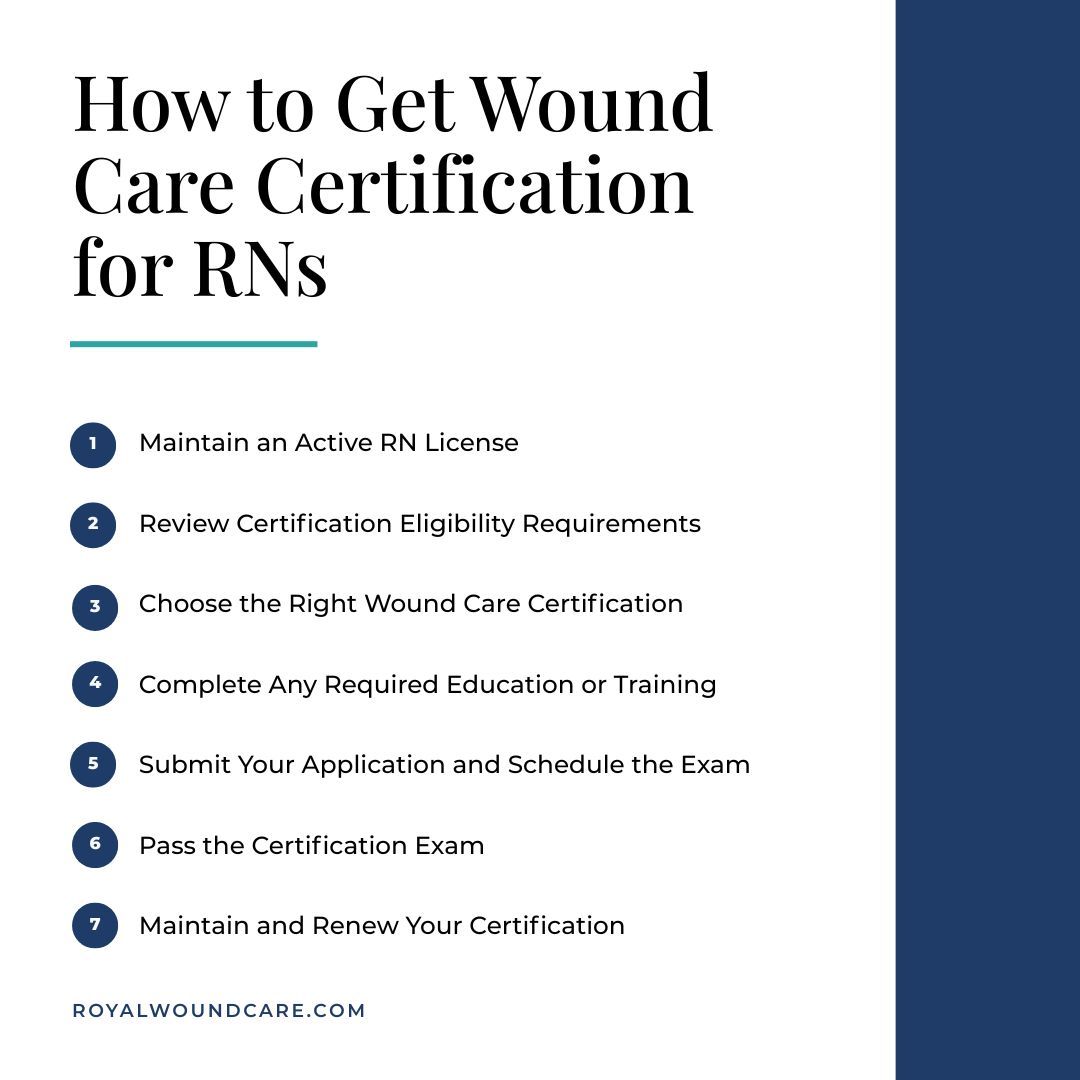
Step 1: Maintain an Active RN License
Most wound care certification programs require candidates to hold an active, unrestricted registered nursing license. Before pursuing certification courses, ensure that your licensure remains active and that you are in good standing. For those who have transferred or moved states in recent years, ensure you apply for reactivation or endorsement.
Step 2: Review Certification Eligibility Requirements
Every wound care certification has unique eligibility criteria. In general, however, many include a combination of nursing experience, wound care clinical hours, continuing education, and the completion of an approved wound care program. Reviewing eligibility requirements early can help prevent delays later. Additionally, it ensures that your chosen certification aligns with your current qualifications.
Step 3: Choose the Right Wound Care Certification
Not all wound care certifications are the same. For example, some focus solely on wound management, while others offer more targeted training across specialties. As we mentioned earlier, there is no universal “best” certification. Your ideal credential should reflect your experience level, long-term career goals, and preferred healthcare setting.
Related: Wound Nurse Certification Programs: How to Become Certified
Step 4: Complete Any Required Education or Training
Many of the certifications we mentioned above require candidates to complete specialized wound care education before applying. This may include an approved education course, continuing education credits, or an accredited, comprehensive wound, ostomy, and continence nursing program.
These educational requirements matter—they’re in place to ensure candidates understand current evidence-based wound care principles, treatment strategies, and best practices. Nonetheless, it’s important to ensure you meet all education and training requirements before applying to reduce delays.
Step 5: Submit Your Application and Schedule the Exam
Once you’ve met the eligibility requirements, you can submit your application. Most organizations require documentation verifying licensure, education, clinical experience, and any previous training programs. Having this information in one place and ready to send is essential for streamlining the process. Next, you can schedule your exam at a time that works best for you.
Step 6: Pass the Certification Exam
After scheduling your certification exam, many providers allocate a specific amount of time for candidates to take the test. For example, as we mentioned above, for the CWOCN certification, you only have 6 months to take the exam. Make sure to take the test as soon as you’re able to, as this reduces stress and timeline delays.
Regardless of the certification, exams evaluate a nurse’s understanding of specialized wound care concepts. This generally includes wound assessment, wound management, prevention strategies, treatment planning, and evidence-based clinical decision-making. To prepare for this, create study materials, use the exam preparation provided by the accreditation bodies, and revisit core wound care concepts.
Step 7: Maintain and Renew Your Certification
Earning your certification is often only the beginning. Most wound care certifications require ongoing continuing education, clinical practice requirements, or periodic recertification to maintain active status. It’s essential that you keep up with continuing requirements in order to maintain certification.
This ongoing professional development helps wound care certified nurses stay current with evolving technologies, treatment modalities, and best practices.
When choosing a wound care certification, consider experience, long-term professional goals, and desired professional setting.
Congratulations! You’ve taken the first step to advancing your career and making a significant difference in the industry. Ultimately, what matters most isn’t how many certifications you earn. It’s choosing a certification pathway that aligns with your goals, experience, and long-term vision for your nursing career. As demand for skilled wound care professionals grows, obtaining a wound care certification can help RNs expand their clinical expertise, strengthen their credentials, and pursue new, exciting opportunities.
Royal Wound Care proudly serves patients and partners with healthcare professionals throughout West Hills, Woodland Hills, Canoga Park, Calabasas, Chatsworth, and the San Fernando Valley. As one of the nation’s few board-certified wound care clinics, our team is committed to advancing excellence in wound care through evidence-based treatment, education, and clinical expertise.
For more information, learn how partnering with Royal Wound Care can bring expert bedside wound management to your skilled nursing facility. From faster pressure ulcer healing times to lower infection rates to fewer wound-related hospitalizations, we understand what it takes to care for patients through every stage of healing—and how to prepare RNs to do the same. Contact the Royal Wound Care team today to learn more.
