
Royal Wound Care is the nation’s leading provider of advanced wound care.
Royal Wound Care is a dedicated wound care center located in West Hills, California, specializing in advanced, comprehensive wound treatment. Founded by Dr. Moaddel, Royal Wound Care was born from his commitment to improve the way patients experience wound care. After witnessing the need for more compassionate, personalized care, Dr. Moaddel opened his own center to ensure that every patient receives the attention and expertise they deserve.
After witnessing the shortcomings in traditional wound care settings, Dr. Moaddel set out to create a better experience—one where patients receive the focused, attentive care they truly deserve. That vision became Royal Wound Care.

Our Mission
To deliver exceptional, accessible wound care tailored to the individual—whether in our state of-the-art clinic, at a skilled nursing facility, or in the comfort of a patient’s home. We treat the wound, but we also care for the whole person.
Why Choose Royal Wound Care?
Ongoing Education & Certification
For staff, families, and partner facilities, including wound in-services and professional training opportunities

Expert-Led Care by Board-Certified Providers
With years of hands-on experience managing chronic and complex wounds

Advanced Modalities
Including negative pressure therapy, mist ultrasound, debridement, Doppler studies, grafts, and more

Survey-Ready Documentation
That keeps facilities compliant and families informed

Truly Personalized Care Plans
Tailored to each patient’s condition, lifestyle, and healing goals

Mobile Services That Come to You
Care delivered at home, in clinics, or within partner facilities

A Team That Cares And The Results To Prove It
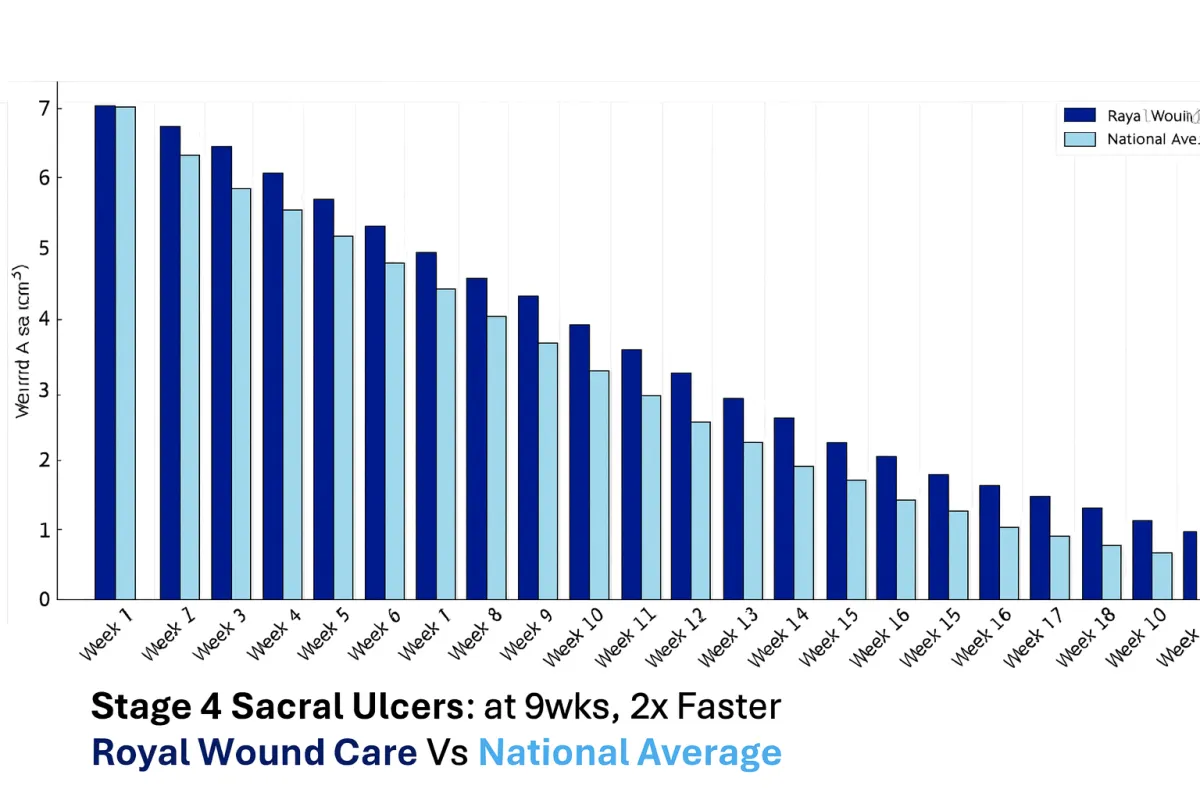
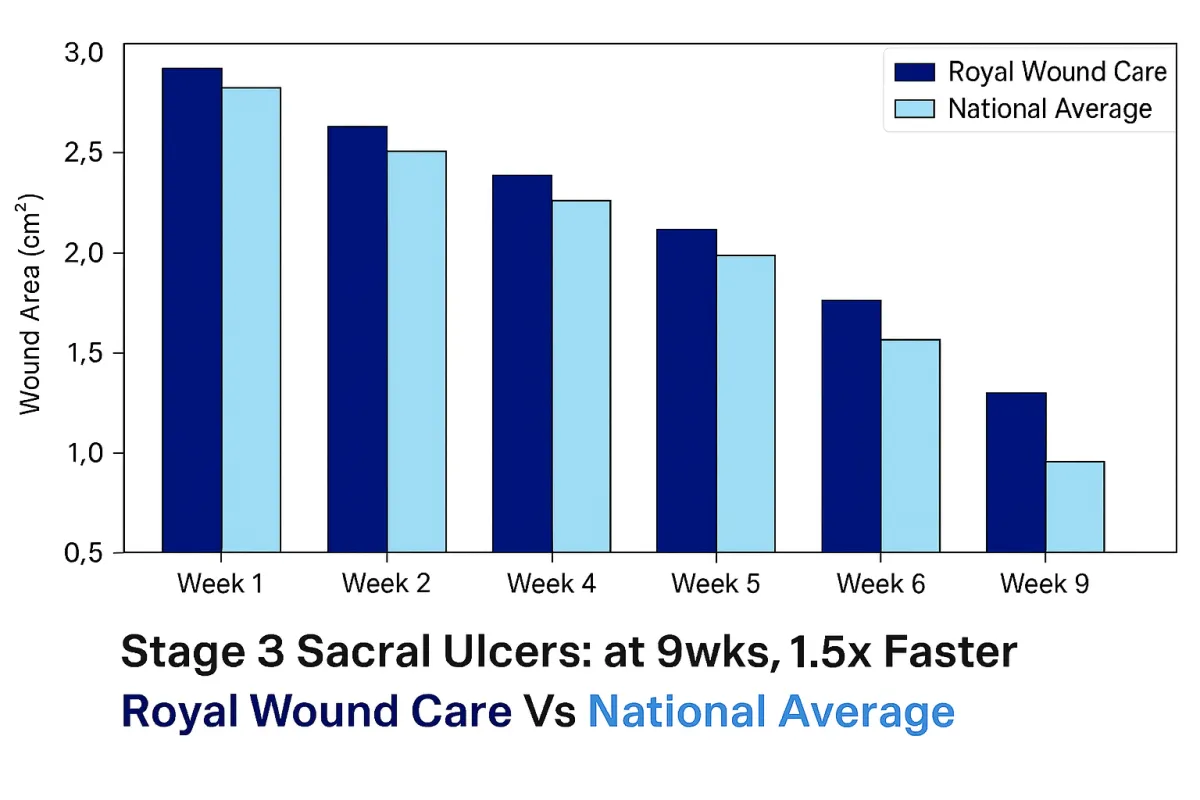
At Royal Wound Care, we deliver results that consistently outperform the national average. Our advanced healing process combines evidence-based treatments, personalized care plans, and direct physician oversight to ensure optimal outcomes. Unlike many clinics, every patient is managed by a board-certified wound care physician who evaluates their condition and customizes treatment from day one.
Our Stage 3 Sacral ulcer graph demonstrates how our approach leads to significantly faster healing compared to the national average. While traditional care results in gradual wound size reduction over several months, patients treated at Royal Wound Care experience more rapid progress through targeted therapies, aggressive infection control, and ongoing physician-directed adjustments to their care plan. Our proactive methods allow us to close even complex wounds weeks earlier than national trends, improving patient mobility, reducing pain, and preventing further complications.
Stage 4 sacral ulcers are among the most complex wounds to treat, yet our outcomes set us apart. Patients at Royal Wound Care heal twice as fast as the national average by leveraging advanced biologic grafts, comprehensive infection management, and customized care protocols. These results highlight our proactive, physician-led care model, allowing us to manage even the most challenging cases successfully while improving long-term patient outcomes.
What Our Partners Experience
86% lower infection rates

47% faster healing compared to others

88% fewer wound-related rehospitalizations

58% faster pressure ulcer healing times

Ready to Heal with Royal Wound Care?

When to Stop Covering an Open Wound: A Wound Care Guide
When to Stop Covering an Open Wound: A Wound Care Guide
Caring for an open wound often comes with real uncertainty, and one of the most common questions is how long the wound should stay protected. You want to do the right thing, but it isn't always clear whether continued coverage is helping or whether your wound is ready for more exposure. That uncertainty is normal, and the answer depends on how your healing is actually progressing.
Wound care changes as a wound heals, so the choice between keeping a wound covered and letting the site breathe isn't a one-time decision. Proper wound care involves more than simply deciding when to pull off a bandage. It means watching the wound, keeping it clean, and responding to what you see at each stage.
At Royal Wound Care, we regularly treat chronic and non-healing wounds across the San Fernando Valley, from our West Hills clinic to bedside care in homes and skilled nursing facilities. That's why Dr. Moaddel, a board-certified wound care specialist, wants to walk you through when covering a wound helps, how long to keep it covered, what to do during healing, and when to seek medical care.

When to Stop Covering an Open Wound: A Wound Care Guide
There isn't one universal point at which every open wound should be left uncovered. A minor scrape on a healthy adult follows a very different path than a deeper laceration or a chronic wound, so the timing that's right for one wound may be wrong for another.
Instead of a fixed rule, look at practical factors that tell you whether continued wound coverings are still doing their job. A wound that has stopped draining, closed at the surface, and formed stable new skin generally needs less protection than a fresh, open, or oozing wound. If the area is still moist, tender, or exposed to friction from clothing, shoes, or daily movement, keeping it covered usually continues to protect it.
The stage of healing matters most. Early on, a covering shields raw tissue and helps keep the wound site clean. As new skin forms and the surface seals, you can often reduce coverage. When a wound remains open, deep, or slow to heal, that's a sign to keep protecting it and to have a professional take a look.
Related: How Long Do Wounds Take to Heal?
Is It Best to Cover an Open Wound?
In most cases, covering an open wound early in healing is the safer choice. A clean covering protects the wound site from dirt, bacteria, friction, and other irritants while your body does its repair work. It also helps maintain a moist wound environment and promotes healing rather than letting the surface dry out.
That said, the decision depends on the injury and its stage of healing. Some minor wounds may not need a covering once they've sealed and are no longer at risk of contamination, while other wounds benefit from continued protection for much longer. For example, deeper injuries, wounds on the hands or feet, and any chronic wound generally need more time under a dressing.
When you do cover a wound, keep it simple and clean. A light layer of antibiotic ointment can help keep the surface moist and prevent infection, followed by a clean bandage sized to the wound. Change the dressing when it gets wet or dirty, because a soiled covering can increase the risk of infection rather than protect against it.
How Long Should You Cover an Open Wound?
There’s no universal timeline for keeping wounds covered. Instead, it’s more useful to understand the factors that affect how long wound coverings should be used.
The size and depth of the injury come first. Small, shallow minor cuts and scrapes may only need a covering for a few days until the surface seals, while deeper or larger wounds need protection for longer. Location is equally important, since wounds over joints, on the feet, or in areas that rub against clothing stay vulnerable and often need coverage until they're fully closed.
Your overall health plays a major role as well. Diabetes, poor circulation, and certain medications can slow the process, and a chronic wound may need managed coverage for weeks under professional guidance. Additionally, signs of drainage, redness, or delayed closure are all reasons to keep the wound protected and reassessed.

What to Do With an Open Wound
Good wound care follows a clear, practical sequence. These basic steps of proper wound care help protect the wound site and support proper healing while you decide whether continued coverage is needed:
Stop the Bleeding
First, stop the bleeding. Apply gentle, steady pressure with a clean cloth or gauze until the flow slows. Most minor wounds stop bleeding within a few minutes. However, if your injury continues bleeding for more than 15 minutes or begins spurting, it may involve deeper blood vessels and needs medical attention.
Related: When to Go to Urgent Care vs. ER for Wound Care
Clean the Wound Gently
Next, clean the wound with mild soap and water to rinse away dirt and debris. Unless specifically advised by your healthcare provider, skip harsh antiseptics like hydrogen peroxide, which can damage healthy tissue and fibroblasts. Gentle rinsing is enough to lower the chance of contamination and prevent infection.
Apply Ointment and Cover
Once the wound is clean, apply a thin layer of antibiotic ointment to keep the surface moist. Afterward, cover it with a clean bandage that fully protects the area. This combination shields the wound site while it heals and helps prevent the dressing from drying onto the surface.
Change the Dressing and Monitor
Change your dressing regularly, particularly if it’s been submerged in water, becomes oversaturated with exudate, or seems as if it’s drying to the skin. Keeping a dressing on a wound for too long can increase the risk of infection or damage delicate tissue.
If you do feel like your dressing is adhering to the skin, follow our guide, “How to Remove Gauze Stuck to Wound Without Pain.” Yanking, tugging or pulling the dressing can damage both injured and healthy skin, possibly causing reinjury. Additionally, as you change dressings, watch for any signs of infection so you can act early.

What Are the Signs of an Infected Wound to Watch Out For
Recognizing the signs of infection early is one of the most important parts of proper wound care. Watch the wound site for these warning signs:
Increasing redness that spreads out from the wound
Warmth around the area
Swelling that gets worse instead of better
Increasing or throbbing pain
Thick, cloudy, yellow, or green drainage, or a foul odor
Fever or feeling generally unwell
A wound that isn't healing or seems to be getting worse
Don't wait for a wound to become severely infected before seeking care. Early attention protects your health and your recovery, and it's especially important if you have diabetes, poor circulation, or a chronic wound. To learn more about protecting your wound and ensuring it heals properly, our article, “How to Know If a Wound Is Infected,” explores this concept in more detail.
When Professional Wound Care Makes The Difference
Some wounds need more than home care and a clean bandage. Deep, large, or heavily contaminated wounds, wounds that won't stop bleeding, and any wound showing signs of infection deserve prompt evaluation by a professional. The same is true for a chronic wound that isn't closing on its own.
At Royal Wound Care, Dr. Moaddel, a board-certified wound care specialist, cares for patients wherever they are, whether that's our West Hills clinic, a skilled nursing facility, or your own home in Woodland Hills, Canoga Park, Chatsworth, or elsewhere in the San Fernando Valley.
Dr. Moaddel brings a diverse background across general surgery, family medicine, and cosmetic surgery, and a holistic approach that treats the whole patient, not just the wound. If you're unsure about a wound that isn't healing the way it should, we're here to help you understand what's happening and what to do next.
Beyond caring for patients, we also strive to educate the future generation of wound care professionals. Learn more by exploring our professional partnership opportunities and advanced educational opportunities for nurses and certified healthcare professionals.
This article is educational and is not a substitute for professional medical evaluation. If you have a wound that concerns you, please see a qualified provider for assessment. To schedule an appointment with Royal Wound Care, call our West Hills clinic at (818) 660-2977.
Dr. Moaddel, Royal Wound Care

WEST HILLS
7230 Medical Center Dr. Suite 100
West Hills, CA 91307
(818)–660–2977
BEVERLY HILLS
9735 Wilshare Blvd #210B
Beverly Hills, CA 90212
(818)–660–2977
Request an Appointment at a Royal Wound Care Facility near you.
Royal Wound Care is the expert in wound healing. Our board-certified wound care specialists are ready to help you begin your healing journey. Click the button below to request an appointment at a Wound Care Center near you—no referral needed
© 2025 Royal Wound Care, LLC. All rights reserved.
site by Growth Partners Marketing