
Nursing Home Wound Care Management: Partnering with Royal Wound Care
From Diagnosis to Recovery—We’re With You Every Step of the Way
At every stage of the healing process—from initial diagnosis to full recovery—our dedicated wound care team delivers expert, compassionate support tailored to the needs of skilled nursing facility (SNF) residents. We specialize in providing a seamless, patient-centered continuum of care that ensures consistent, high-quality treatment throughout each resident’s journey to healing.
Our Skilled Nursing services include:
Skilled Observation and Assessment
Regular monitoring and evaluation of your health to ensure proper care and early detection of changes.
Diabetic Management
Expert guidance in managing diabetes, including blood sugar monitoring and insulin management.
Wound Care
Specialized care for wound healing, including dressing changes and infection prevention.
Medication Supervision
Assistance in managing medications and ensuring proper dosages and schedules.
Intravenous Therapy
Administering IV treatments such as hydration and antibiotics safely at home.
Total Parenteral Nutrition (TPN)
Providing nutritional support for patients unable to eat or absorb food normally.
Pain Management
Developing personalized pain control strategies to enhance comfort and quality of life.
Respiratory Treatment
Managing and supporting respiratory conditions with appropriate therapies.Incontinence Care
Helping with personal care and providing strategies for managing incontinence.
Catheter and Ostomy Care
Expert care for catheter and ostomy patients to ensure comfort and proper function.
Patient and Family Health Education
Offering training and guidance to ensure patients and families are equipped to manage ongoing care needs.
For questions regarding our skilled nursing facilities, please contact 818–660–2977
Clinical Excellence,Faster Healing, Better Outcomes: How Royal Wound Care Outperforms National Benchmarks
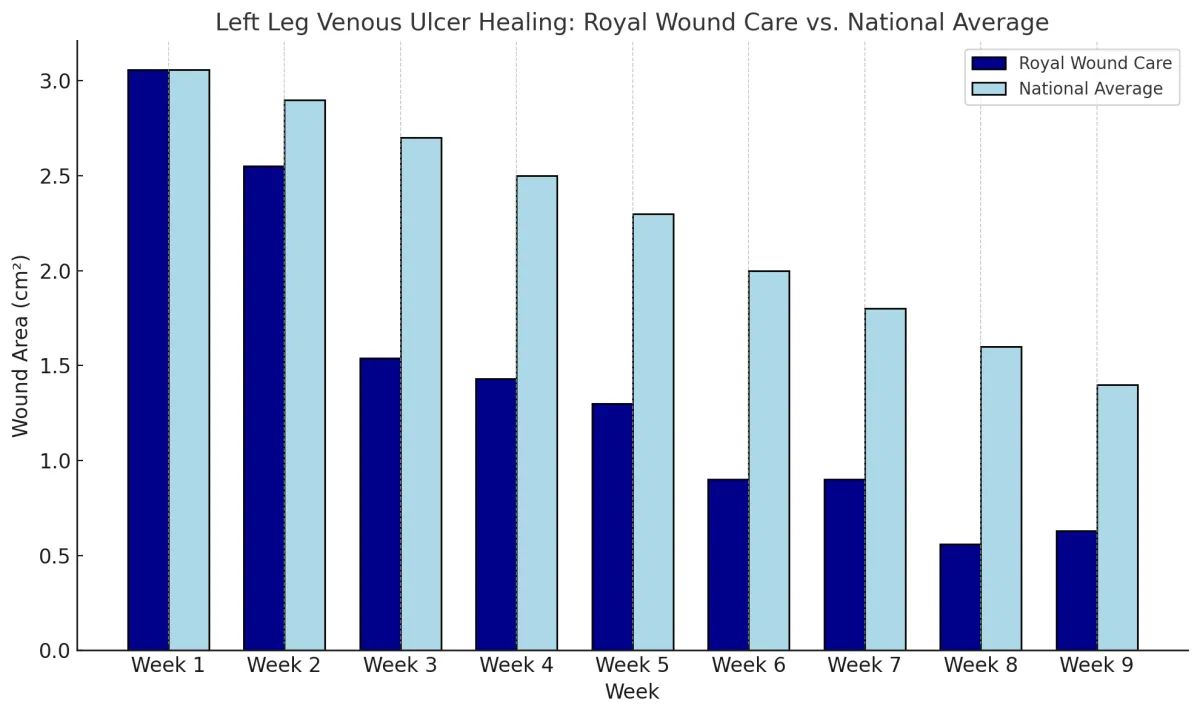
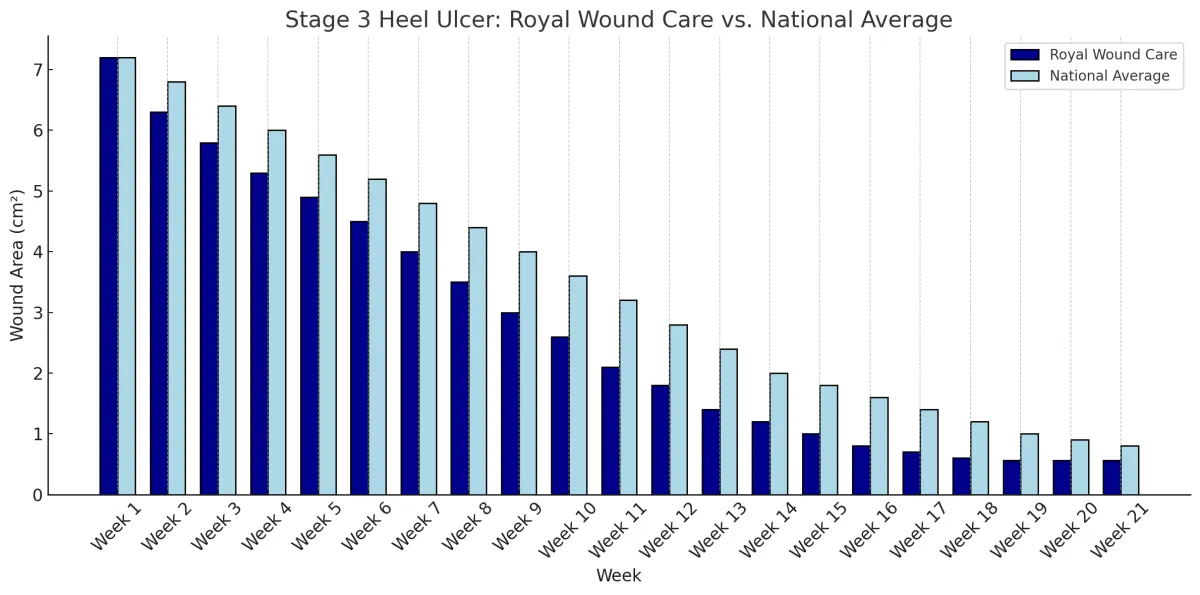
At Royal Wound Care, we deliver results that consistently outperform the national average. Our advanced healing process combines evidence-based treatments, personalized care plans, and direct physician oversight to ensure optimal outcomes. Unlike many clinics, every patient is managed by a board-certified wound care physician who evaluates their condition and customizes treatment from day one.
Our venous ulcer graph highlights our success in treating one of the most challenging chronic wounds. Venous ulcers are often slow to heal and prone to recurrence, but at Royal Wound Care, we address not only the wound itself but also its underlying causes. Through vascular assessments, compression therapy, advanced grafts, and customized treatment protocols, our patients consistently heal faster than those receiving standard care elsewhere. This comprehensive, physician-led approach results in better long-term outcomes and fewer hospitalizations.
Our Stage 3 heel ulcer graph demonstrates how our approach leads to significantly faster healing compared to the national average. While traditional care results in gradual wound size reduction over several months, patients treated at Royal Wound Care experience more rapid progress through targeted therapies, aggressive infection control, and ongoing physician-directed adjustments to their care plan. Our proactive methods allow us to close even complex wounds weeks earlier than national trends, improving patient mobility, reducing pain, and preventing further complications.
For more expert tips, insights, and updates on wound care, check out our blog.
How to Treat a Laceration: Proper Wound Care and Healing Tips
How to Treat a Laceration: Proper Wound Care and Healing Tips
Lacerations are one of the most common types of injuries, ranging from minor paper cuts to deep tissue injuries. No matter the severity, knowing how to treat a laceration is an essential step toward healing properly. Additionally, prompt and attentive care can help reduce the risk of infection, future complications, and improper repair.
Because lacerations vary in severity, depth, and length, many patients are unsure how to care for them properly. While some were taught to clean the wound with hydrogen peroxide and apply a simple bandage, this approach can actually delay the healing process and irritate the injury.
Wound care is not a one-size-fits-all. That’s why this guide walks you through how to effectively care for a laceration wound. We will explain what a laceration is, what commonly causes it, how long healing typically takes, and the most important steps to support proper recovery.

How to Treat a Laceration: Proper Wound Care and Healing Tips
A large U.S.-based clinical study found that laceration treatment accounts for approximately 8 million emergency department visits each year. From at-home falls and kitchen accidents to vehicle collisions and animal bites, this type of wound is incredibly common—and generally easy to treat.
That said, at Royal Wound Care, we simplify treatment by focusing on the core principles that drive long-term recovery—one of which is proper education. So today, we will discuss how to successfully treat a laceration to prevent infection, accelerate healing, and reduce complications.
Whether you’re a licensed nurse operating in a clinical setting or a patient trying to determine when medical attention is necessary, this guide will provide clear, practical information you can rely on.
What Is a Laceration?
A laceration is a wound caused by the tearing, ripping, or cutting of the skin and soft body tissues from a sharp object or blunt trauma. Unlike minor abrasions, a laceration is a wound that has irregular, uneven edges and can be either superficial or deep.
Minor lacerations, such as those caused by shaving or friction against rough surfaces, are often shallow. As a result, they generally don’t require extensive care or visits to a wound care facility. Deep lacerations, on the other hand, like those caused by animal bites or motor vehicle accidents, require entirely different care.
These wounds often damage deeper structures—such as nerves, muscles, or bone—and may involve bleeding that does not stop after 15 minutes of direct pressure.
In either case, a laceration indicates that the skin barrier is broken. Therefore, these wounds are more prone to bacterial infections and complications, making proper treatment crucial for long-term recovery.
Related: Caring for Your Wound

What Can Cause a Laceration?
Lacerations can happen suddenly and in a variety of everyday situations, including:
Accidental kitchen slips from knives, graters, or other sharp utensils
Falls or collisions, often on rough or hard surfaces
Power tools or machinery
Sports-related injuries (biking, running, or contact sports)
Animal or human bites
Vehicle accidents
Depending on the object that caused the laceration, you may experience clean cuts or irregular, star-shaped wounds. It’s important to evaluate the injury immediately to determine whether it requires medical care for proper healing.
How Long Does a Laceration Take to Heal?
The healing time of a laceration depends significantly on its size, location, and depth. Those aren’t the only important factors, though. The individual’s overall health, diet, age, and lifestyle also play a vital role in recovery timelines.
For additional information on how nutrition impacts healing, visit our guide, “What to Eat for Faster Wound Healing.” We thoroughly explain how proteins, vitamins, and minerals support recovery and tissue repair.
Moreover, minor lacerations, for example, can successfully heal within 1–2 weeks. Deeper lacerations, which often require stitches, typically fully heal within 6–8 weeks. Severe lacerations—such as ring avulsions or wound dehiscence (where a wound that re-opens)—can take months to years to heal.
Ultimately, immediate proper care can make all the difference in quickly and successfully a wound heals. Below, we will explore the necessary steps for caring for a laceration, followed by expert guidance on when to consider visiting a wound care specialist.
Related: How Long Does It Take for a Wound to Heal? What Every Nurse and Patient Should Know

How to Treat Laceration Wounds
Stop the Bleeding
Stopping the bleeding is the first step to caring for any laceration. To do so, apply firm, direct pressure with a clean cloth or sterile gauze and elevate the wound if possible. If the bleeding doesn’t seem to slow or stop after 15 minutes, seek medical attention immediately.
Uncontrolled blood loss can quickly lead to shock, organ damage, or loss of consciousness. Even if the bleeding persists, keep applying pressure until help arrives or you reach the facility.
Clean the Wound
As we mentioned earlier, many people assume that antiseptics, like hydrogen peroxide and alcohol, are safe to use on wounds. While these cleaning agents do remove bacteria, they can also negatively affect normal tissue repair.
Additionally, research shows that antiseptics reduce fibroblast viability and increase the percentage of apoptotic cells. Essentially, harsh cleansers make it harder for wounds to close and, therefore, heal.
Once you control the bleeding, rinse the area with cool, clean water to remove any dirt and debris. Afterwards, ensure you don’t rub the area dry, as this can further irritate the injury. Instead, gently pat the laceration with a clean cloth.
Related: A Nurse’s Step-by-Step Checklist
Apply Antibiotic Ointment
After cleaning the wound with water and gently drying it, apply a thin layer of antibiotic ointment or a prescribed medication. Doing so delivers a potent dose of medicine right to the wound bed, killing any potential bacteria and preventing infections.
Moreover, ointments will also help keep the wound moist—a factor shown to promote re-epithelialization and aid in optimal tissue repair.
Dress the Wound
Many patients believe that proper care ends at cleaning the injury and applying ointment. However, contrary to previous beliefs that wounds need to “breathe” to heal, it’s actually just as important to cover the wound.
Wound dressings accelerate healing, protect new cells from drying out, and absorb any potential drainage. To do this, use a clean bandage that fully covers the laceration without being too tight. Keeping the wound covered during the early stages can significantly reduce the risk of infection and improve long-term healing.
Monitor for Signs of Infection
As the wound heals, it’s important to monitor for any signs of infection. A bacterial wound infection will appear as pus, redness, swelling, and warmth. Viral infections, in comparison, may cause itching, tingling, fevers, or widespread sores.
In either case, it’s important to contact a healthcare professional to evaluate the wound immediately. Catching an infection early significantly reduces the likelihood of long-term complications, such as chronic wounds, tissue death, or lifelong pain.
Know When to Visit a Wound Care Specialist
Some lacerations require professional medical attention, especially if they are deep, continue bleeding, expose underlying tissue, or result from animal bites or contaminated objects. When in doubt, the team at Royal Wound Care is here to assist patients from diagnosis to complete recovery.
With evidence-based clinical guidelines, cutting-edge research, and a board-certified staff, we pride ourselves on reducing hospitalizations and lowering infection rates. No matter the wound, contact Royal Wound Care—we’re here to help.
Related: When to See a Wound Care Specialist: Signs It’s Time to Get Expert Help
Proper care is essential for lacerations to heal safely and effectively.
Treating a laceration involves far more than simply cleaning and covering the injury. Appropriate wound care and attention to infection prevention are essential for long-term recovery. When cared for from the start, patients can reduce the risk of complications and aid in optimal healing.
At Royal Wound Care, we don’t just treat the wound—we care for the individual. Our highly-trained team can assess each injury to formulate a personalized approach for your unique experience. Healing doesn’t have to feel isolating, especially when you recover with Royal Wound Care.
Additionally, SNFs and independent nurses can greatly benefit from our advanced education opportunities and professional partnerships. Reach out today to learn how you, too, can experience faster healing and clinical excellence through hands-on training and expert-led techniques.

WEST HILLS
7230 Medical Center Dr. Suite 100
West Hills, CA 91307
(818)–660–2977
BEVERLY HILLS
9735 Wilshare Blvd #210B
Beverly Hills, CA 90212
(818)–660–2977
If you are interested in making an appointment, please click here to find a Wound Care Center near you.
Request an Appointment at a Royal Wound Care Facility near you.
Royal Wound Care is the expert in wound healing. Our board-certified wound care specialists are ready to help you begin your healing journey. Click the button below to request an appointment at a Wound Care Center near you—no referral needed
© 2025 Royal Wound Care, LLC. All rights reserved.
site by Growth Partners Marketing