
How much does a wound care nurse make? A 2026 salary guide by state, setting, and certification
How much does a wound care nurse make? A 2026 salary guide by state, setting, and certification
How much does a wound care nurse make? Wound care is one of the most in-demand nursing specialties out there, and it offers strong earning potential, too. According to ZipRecruiter (October 2026), the average wound care nurse salary is about $101,711 a year.
But as with all nursing jobs, there's quite a bit of variation. Pay depends on a nurse's license, certification, level of experience, work setting, and geographic location. Compare a certified nurse practitioner in a California hospital with a newly licensed LPN in a rural skilled nursing facility. Their pay can differ by tens of thousands of dollars.
At Royal Wound Care, Dr. Moaddel's board-certified, physician-led team collaborates with and trains wound care nurses in San Fernando Valley skilled nursing facilities. We witness firsthand what certifications employers look for and how qualified nurses move into higher-paying positions. That's why we'll cover average wound care nurse salaries by license, certification, state, work setting, and experience. We'll also show you how much the highest-paid wound care nurses earn and how you may realistically increase your pay.
How Much Does a Wound Care Nurse Make? A Quick Answer
According to ZipRecruiter (October 2026), the average salary for a wound care nurse is $101,711/year ($48.90/hour). Most wound care nurses make between $71,500/year (25th percentile) and $130,000/year (75th percentile). Top earners (90th percentile) make around $156,500/year.
Bureau of Labor Statistics data (May 2025) puts the median annual wage for US registered nurses at $97,550/year ($46.90/hour). The BLS doesn't collect data specific to wound care nurses. So many sites use the RN numbers as a baseline for estimating wound care nurse salaries. Registered nurses who've further specialized in wound care tend to make a bit more than the RN median. That's due to the extra training and expertise required in this field.
Quick salary summary
Metric | Figure (source) |
Average annual salary | $101,711 (ZipRecruiter, Oct 2026) |
Hourly rate | $48.90 (ZipRecruiter, Oct 2026) |
Typical salary range | $71,500 to $130,000 (ZipRecruiter, Oct 2026) |
Top earners (90th percentile) | $156,500 (ZipRecruiter, Oct 2026) |
Top-paying state (RN baseline) | California, $150,280 mean (BLS, May 2025) |
Top-paying setting (RN baseline) | Government, then hospitals (BLS, May 2025) |
Average Salary vs. Base Salary vs. Salary Range
You might see references to a job's average (or mean) salary, base salary, or salary range. Knowing the difference can help you make sense of salary data and evaluate a potential employer's salary offer. An average (or mean) salary is determined by adding up all salaries and dividing by the total number of people surveyed. Average salaries can be skewed by extremely high or low salaries.
Base salary is the employee's fixed salary. It doesn't include any additional compensation, such as pay for working overtime, shift differentials, or holding certain certifications. Salary range is the range of annual salaries paid to employees in a particular occupation, often expressed in percentiles. For example, a salary range of $35,000 to $45,000 might refer to the 25th to 75th percentile. That means 50% of people surveyed earned between $35,000 and $45,000.
Wound Care Nurse Salary by License and Education
In general, the more advanced a nurse's education and credentials are, the more you can expect to be paid. The salaries for wound care nurses climb steadily as you move from LPN to RN to nurse practitioner. For example, a wound care-certified nurse practitioner can expect to make significantly more than a newly licensed practical/vocational nurse (LPN/LVN).
LPN Wound Care Nurse
Licensed practical nurses handle a lot of hands-on, day-to-day wound care. That includes dressing changes, monitoring, and documentation under the supervision of an RN or physician. LPN wound care nurses make about $62,140 per year ($29.88/hour), according to ZipRecruiter data as of October 2026.
LPN wound care nurse salaries typically range from $51,500 to $70,000, with top earners (90th percentile) making about $84,000. Across all specialties, the BLS (May 2025) puts the median annual wage for LPN/LVNs at $64,400 ($30.96/hour).
RN Wound Care Nurse
Registered nurses are responsible for more than just assessment; they also manage care planning, educate patients, and coordinate treatments. This is what most people picture when they think of a wound care nurse. With wound care training, RNs can earn more than the BLS median for all registered nurses.
Wound Care Nurse Practitioner
A wound care nurse practitioner holds a graduate degree and can assess, diagnose, and manage complex wounds with far more autonomy. Wound care nurse practitioners make an average of $130,295 per year ($62.64/hour), according to ZipRecruiter data as of October 2026. Nurse practitioners in wound care typically earn between $108,000 and $150,000, with the highest earners (90th percentile) making around $180,000. According to the BLS (May 2025), the median annual wage for all nurse practitioners is $132,300.
BSN and MSN
Furthering your education can qualify you for higher-paying jobs, and it may also come with a pay bump at your current position. For example, according to a Nurse.org salary survey, nurses with a BSN make an average of $3.89/hour more than their ADN-holding counterparts. An MSN opens the door to advanced practice roles. According to the BLS (May 2025), the median annual wage for nurse anesthetists, nurse midwives, and nurse practitioners is $134,920.
Does Certification Increase Wound Care Nurse Salary?
In our experience, yes, and it's one of the most reliable ways to raise your earning ceiling. Our experience has shown that wound care specialty nursing certifications can help increase your salary. Wound care nurse certification can raise your earning potential. It also shows that you meet a national level of competency in the specialty. Some employers also offer a certification differential, often a flat amount added to your annual or hourly pay.
So how much do certified wound care nurses make? There's little salary data specific to Certified Wound Care Nurses (CWCNs). Wound care-certified RNs often bring in more than non-certified RNs. So RNs who earn the CWCN credential may see a raise as well. Certification can also help you land higher-paying roles, such as wound care coordinator or wound care lead nurse.
Common Credentials
There are several wound care specialty credentials nurses can earn. Each credential has its own eligibility requirements, exam, and CE/renewal requirements. The most common include:
Certified Wound Care Nurse (CWCN), offered by the Wound, Ostomy and Continence Nursing Certification Board (WOCNCB)
Certified Wound, Ostomy and Continence Nurse (CWOCN), offered by the WOCNCB
Certified Wound Specialist (CWS), offered by the American Board of Wound Management (ABWM). It's open to licensed professionals with a bachelor's degree or higher, or RNs with an associate's degree. Candidates also need 3 or more years of wound care experience.
Wound Care Certified (WCC), offered by the National Alliance of Wound Care and Ostomy (NAWCO)
The CWOCN is a good example of how detailed these rules can be. To be eligible to take the CWOCN exam, you'll need a current RN license and a bachelor's degree or higher. You'll also need to meet one of the following education/experience requirements:
Completion of an accredited WOC nursing education program within the past five years, or
4,500 practice hours in ostomy/wound/continence nursing within the past five years, with 1,125 in the past year. You'll also need 50 contact hours of continuing education in each specialty.
To learn more about which certification is right for you, explore each of the credentials mentioned above. Compare their eligibility, exam, and renewal requirements before you commit. Each certifying body lists its current rules on its own site.
Related: Wound Nurse Certification Programs: How to Become Certified
Wound Care Nurse Salary by State
Geography is another important factor that influences registered nurse salaries and, by extension, wound care nurse salaries. The Bureau of Labor Statistics doesn't have salary data on wound care nurses. So we can only use RN pay as a general indicator. According to the BLS (May 2025), California RNs make the most at $150,280 per year on average. RNs in Alabama make the least at $77,020 per year.
State | Mean annual RN wage (BLS, May 2025) |
California | $150,280 |
Hawaii | $124,340 |
Oregon | $123,140 |
Washington | $121,540 |
Massachusetts | $117,960 |
Mississippi | $78,950 |
South Dakota | $77,140 |
Alabama (lowest) | $77,020 |
However, keep in mind that RN salaries in California (and other states) may seem impressive. When you factor in the higher cost of living, that high wage isn't always as advantageous as it seems. Adjusted for cost of living, California's mean RN wage drops to about $135,700 per year. That's based on the BEA's 2024 price parity for California.
If you're already working as a nurse in California, it pays to crunch the numbers before chasing a higher-salaried job. That's especially true in high-cost areas like West Hills, Woodland Hills, Canoga Park, Chatsworth, or Calabasas. Compare housing and commuting costs along with the salary itself.
Which Cities Pay Wound Care Nurses the Most?
If you're open to relocating, it helps to know which cities pay the most. According to BLS data (May 2025), RNs in the San Jose-Sunnyvale-Santa Clara metro make the most in the country. They average $194,950 per year. Other California metros follow close behind:
Vallejo, CA: $182,820
San Francisco-Oakland-Fremont, CA: $176,900
Within the specialty itself, wound care nurse salaries in New York, NY average $111,276 per year. That's 9.4% higher than the national average wound care nurse salary. City-level pay often outpaces the statewide average, especially in major metros.
Wound Care Nurse Salary by Work Setting
The type of facility or work setting you choose can also impact your pay. So can the job itself, since duties and caseloads vary by setting. The BLS (May 2025) reports that the industries that employed the most registered nurses were:
Hospitals (state, local, and private): 59% of RNs
Ambulatory healthcare services, which include outpatient care: 19%
Nursing and residential care facilities: 6%
Travel and contract nursing jobs can also be some of the highest-paying, though the BLS doesn't track them separately. Below, we cover typical pay and day-to-day work in each setting. That way, you can weigh pay against the lifestyle you want.
Hospitals and Acute Care
Hospital wound care nurses deal with the most serious and complicated wounds, like surgical wounds and severe pressure ulcers/injuries. They may also pick up extra pay for night or weekend shifts. The pace is fast, and the cases are varied. According to the BLS, the median RN wage in hospitals was $100,220 in May 2025.
Outpatient Wound Care Clinics
Outpatient wound clinics (like our clinic in West Hills) typically treat chronic, non-healing wounds. Patients often have venous ulcers or diabetic foot ulcers. For nurses who value predictability, outpatient wound care clinics can offer more consistent schedules than hospital settings.
RNs in these settings also rely heavily on assessment and patient education skills to help their patients heal. The BLS groups these clinics under ambulatory healthcare services, where the median RN wage was $91,230 (May 2025).
Home Health
Wound care nurses who work for home health companies travel to patients' homes to provide skilled nursing care and services. Wound care duties include wound assessment, monitoring for signs/symptoms of infection, and dressing changes. Nurses also educate patients and families on proper wound care techniques. The BLS doesn't report a separate home health figure in its RN summary. Home health falls under ambulatory healthcare services, where the median RN wage was $91,230 (May 2025).
Home care nurses tend to have a lot of autonomy. They should also enjoy driving, since they'll travel from one patient's home to the next. Home health wound care lets nurses provide convenient care for patients who have difficulty coming into an outpatient wound care center. It's an important service for patients all across the San Fernando Valley.
Skilled Nursing and Long-Term Care
Skilled nursing/long-term care facilities see lots of patients who are at high risk for developing pressure injuries, or who have diabetes. In the skilled nursing facilities where we work, this is often where a certified wound care nurse adds the most value. Having a wound care nurse on staff, particularly a certified one, can help reduce wound care complications and readmissions.
That's why these jobs can be competitive. The median RN wage in nursing and residential care facilities was $84,300 (BLS, May 2025). Our guide to pressure ulcer stages, prevention, and treatment in nursing homes shows the kinds of wounds these nurses manage.
Travel Wound Care Nursing
Travel nursing can pay some of the highest salaries in the RN world. That's because travel nurses accept temporary positions to fill staffing shortages. The BLS doesn't track travel nurse pay separately.
Pay depends on the contract and often includes stipends for housing and meals. The jobs can be demanding, since travel nurses move a lot and have to quickly adapt to new hospital/medical center environments. But for wound care nurses looking for the highest paying jobs, it's a proven route.
Wound Care Nurse Salary by Experience
Like most jobs, nurses with more years of experience typically command higher wages than their less experienced counterparts. Entry-level wound care nurses tend to make on the lower end of the pay scale. They're still learning wound assessment techniques, proper dressing selection, and similar skills. As wound care nurses gain experience, they take on more complex patients/cases. Their pay then tends to fall in the middle to upper end of the scale.
Wound care nurses who earn additional degrees or move into nurse leadership may also earn more. Leadership roles include RN wound care coordinator and wound care program director. Wound care nurse coordinators/directors typically oversee wound care protocols, nurse education/training, and patient outcomes within their medical center. These are some of the highest-paying jobs available to RNs who specialize in wound care.
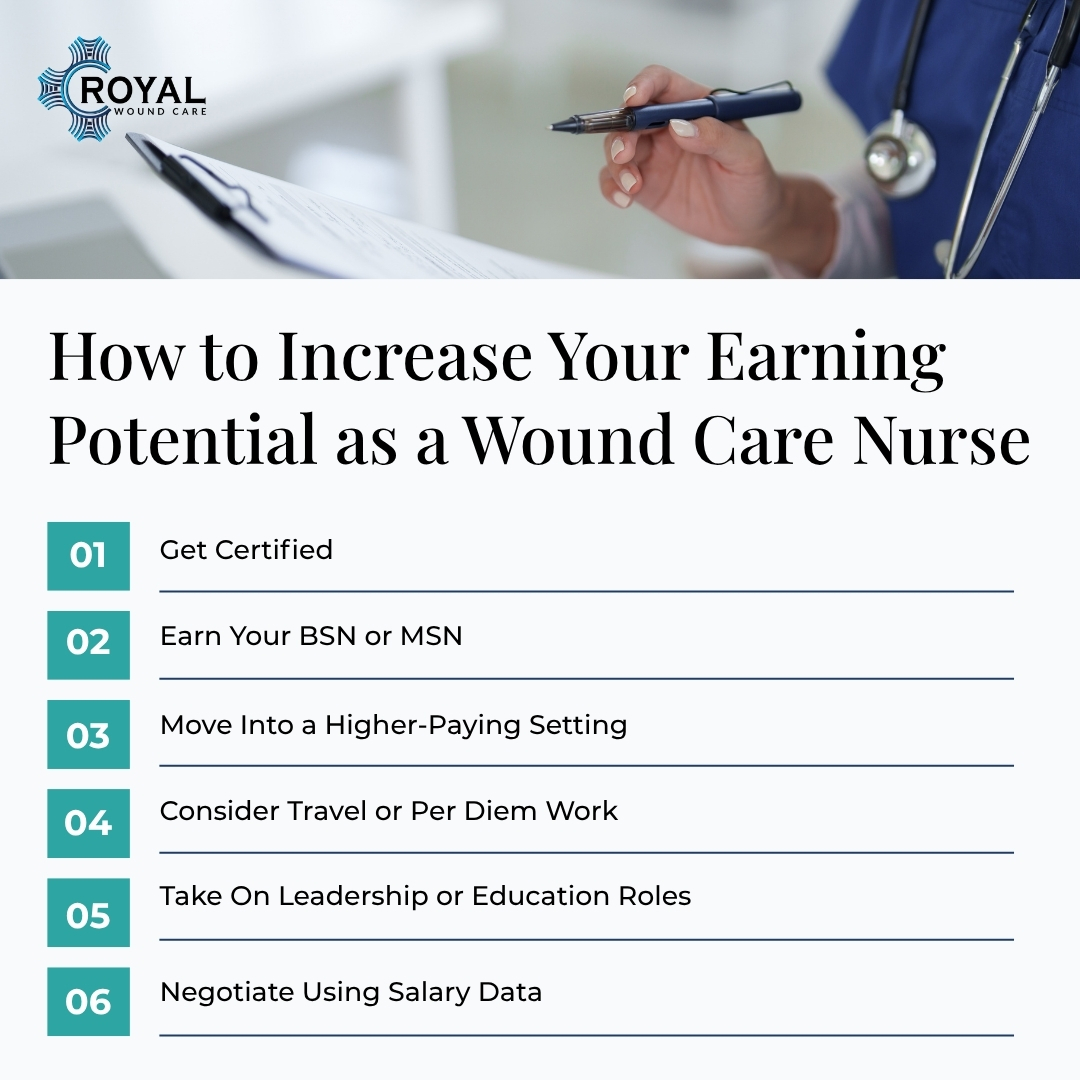
How to Increase Your Earning Potential as a Wound Care Nurse
There's no such thing as a guaranteed raise in nursing. But there are ways to improve your earning potential that work again and again. Here are six of the most reliable options we've seen make a difference for nurses:
Get Certified
Earning certification can be one of the best investments you can make as a nurse. It can boost your earning potential as well as your job opportunities. Our Wound Care Nurse Certification (WCN-C) course is a nationally recognized course open to licensed nurses and clinical teams. It's built for nurses seeking continuing education units (CEUs), recertification, and wound care skills training.
The self-paced online course is open to LVNs, LPNs, and RNs. It offers 8 contact hours of continuing education for RNs, approved by the California Board of Registered Nursing (Provider CEP 18268). The course can help nurses expand their wound care expertise and take on coordinator or lead roles. Not sure how to get started as a wound care nurse? Our guide on how to become a wound care nurse can help.
Earn Your BSN or MSN
Nurses who have a bachelor of science in nursing (BSN) typically earn more than their peers who only have an associate's degree. Earning a master of science in nursing (MSN) could allow you to become a nurse practitioner. That's a position that typically pays considerably more than the average RN wage.
Move Into a Higher-Paying Setting
Some settings (and jobs) simply pay more than others. If you currently work in a lower-paying setting, consider changing jobs (not careers). Look at a hospital or specialty outpatient wound clinic position, or work as a travel nurse. All of these options could increase your pay without requiring you to earn another degree. Each setting has its own pros and cons, so choose the one that best matches your desired lifestyle.
Consider Travel or per Diem Work
Per diem and travel positions often pay a premium for the flexibility you provide. If you're open to an inconsistent schedule or shorter-term contracts, consider one of these jobs to make more money as a nurse. Per diem shifts can also be a low-risk way to try a new setting before you commit.
Take On Leadership or Education Roles
Taking on additional responsibilities (and pay) as a nurse educator, lead nurse, or wound care coordinator could be a great next step. It suits nurses who have strong clinical skills and a desire to help educate and mentor other nurses. It also suits nurses with the ability to improve processes/outcomes for the entire facility.
Negotiate Using Salary Data
Bring up-to-date data the next time you request a raise or negotiate a new job's starting salary. Knowing the average annual salary for your license, work setting, and location will help you make your case. Advertised salaries for similar nurse job openings help, too. Together, they let you ask for a higher salary in a specific, credible way.
Wound Care Nurse Salary FAQs
How much does a wound care nurse make an hour?
Wound care nurses make an average of $48.90 per hour, according to ZipRecruiter (October 2026). That hourly rate is based on an average annual pay of $101,711. Hourly pay depends on factors like license, work setting, and location.
Do wound care nurses make more than regular RNs?
In general, wound care nurses can earn a little more than registered nurses without a wound care specialty. The median salary for all registered nurses is $97,550 (BLS, May 2025). The average wound care nurse earns around $101,711 (ZipRecruiter, October 2026).
Additional training/certification as a wound care nurse may justify higher pay in this specialty. Keep in mind that these two figures come from different sources and measures. One is a median and the other is an average, so treat the gap as a rough guide.
What is the highest paying wound care nurse job?
Some of the top-paying jobs in wound care include travel nursing, nurse practitioner roles, and coordinator or program director jobs. Wound care nurse practitioners make an average of $130,295 per year (ZipRecruiter, October 2026). Pay also varies by employer and region, so compare current listings to find the highest paying companies in your area. Some of the highest paying areas for nurses are found in certain cities in California.
Is Wound Care Nursing in Demand?
Yes, the Bureau of Labor Statistics expects about 180,800 registered nurse job openings per year through 2035. Demand for nurses who specialize in wound care is likely to keep growing. That's due to an aging population and high rates of diabetes, which can cause wounds to develop and resist healing.
Royal Wound Care's self-paced Wound Care Nurse Certification course was developed for nurses looking to advance their careers in this in-demand specialty. Are you an RN or facility partner in Woodland Hills, West Hills, or the greater San Fernando Valley? You can learn more about our wound care certification for RNs.
Written by Dr. Moaddel, Royal Wound Care
This content is for informational purposes only and is not a substitute for medical or career advice. Salary information cited from third-party sources as noted; actual data may vary and change over time.
