
Does Medicare Cover Wound Care? Understanding Your Benefits
Does Medicare Cover Wound Care? Understanding Your Benefits
Wound care is often more than a one-time medical appointment. In fact, for those dealing with chronic wounds, recovering from surgery, or managing underlying health conditions, wound care services become an ongoing part of their health care routine. And when navigating regular appointments, specialized treatments, and in-home health care, costs can add up quickly.
Many patients assume that Medicare will cover all aspects of treatment, only to find that unexpected out-of-pocket expenses and coverage limitations later. Not only does this cause reasonable frustration, but it also leads to hesitation about receiving future care.
In this post, we’re answering one common question: “Does Medicare cover wound care?” We’ll provide a comprehensive breakdown of coverage limitations, approved amounts, and how to qualify for the benefits available under your plan. With this, you can better prepare for potential wound care treatments moving forward.
Royal Wound Care, a dedicated wound care center in West Hills, is committed to providing transparent, compassionate care while helping patients navigate the complexities of treatment and insurance coverage. Whether receiving in-clinic wound care or exploring our online resources, our goal is to help patients feel empowered, informed, and confident.
Does Medicare Cover Wound Care? Understanding Your Benefits
In many cases, wound care involves far more than treatment alone. Specialized supplies, medical equipment, and ongoing professional oversight can all play an important role in the healing process—and contribute to overall costs.
By understanding Medicare coverage, patients can make informed decisions and avoid unexpected costs. At the same time, it can also help patients plan properly, work with approved providers, and ensure they have access to the care necessary for optimal healing.
Managing wound care can be an overwhelming process, especially when trying to understand insurance coverage. To help, this guide explains how Medicare handles wound care, which services may be covered, and what patients should know before beginning treatment.
Related: Wound Care Los Angeles: Why Skilled Nursing Facilities Trust Royal Wound Care
What Is Medicare?
Medicare is a federal health insurance program primarily for individuals aged 65 and older. However, certain younger individuals with disabilities or End-Stage Renal Disease (ESRD) may qualify for coverage as well.
Medicare is divided into several parts, including:
Original Medicare
Medicare Part A (Hospital Insurance) generally covers inpatient hospital stays, skilled nursing facility care, and certain home health care services. Many patients do not pay a monthly premium so long as their spouse paid Medicare taxes.
Medicare Part B (Medical Insurance) covers outpatient care, physician visits, preventive services, and lab equipment. In many cases, this tier also covers medically necessary treatments or services that keep patients healthy, such as wellness visits or flu shots.
All-in-One Insurance Plans
Medicare Part C (Medicare Advantage) is offered through private insurance companies approved by Medicare. By bundling Part A and Part B, Medicare Advantage combines benefits while offering additional perks.
Supplemental Insurance Coverage
Medigap is additional private insurance used to cover “gaps” in original plans. It ultimately helps patients pay out-of-pocket healthcare costs, often including deductibles and copayments.
Medicare Part D (Prescription Drug Coverage) is an optional, federally approved private insurance plan that helps patients pay for outpatient prescription drugs.
Ultimately, Medicare coverage depends on the type of wound, medical necessity, setting, and care plan. In many cases, patients are either enrolled in “Original Medicare” or “Medicare Advantage.” It’s important to understand that one isn’t universally better—it depends on budget, needs, and doctor preference.
Is Wound Care Covered By Medicare?
In many cases, yes, Medicare does cover wound care! However, coverage for wound care varies depending on several factors, such as:
Type of wound
Treatment setting
Level of care required
Supporting medical documentation
Medical necessity
Enrolled plan
Medical standards
For example, Medicare Part A may cover surgical wound treatments performed in an inpatient facility. However, it may not cover newer experimental treatments, such as certain stem cell procedures, that lack clinical supporting evidence.
Above all, it’s essential to ensure your plan meets your unique health needs, desired hospital or physician network, and long-term treatment goals. Not only does this reduce confusion, but it can also help maximize your available benefits and minimize unexpected out-of-pocket expenses.
Related: The Difference Board-Certified Physician Leadership Makes in Nurse Wound Care Education
Does Medicare Cover Wound Care at Home?
Medicare can cover certain wound care services delivered at home, provided patients meet eligibility requirements. However, it’s important to understand exactly what this means, as Medicare separates at-home and outpatient care into different plans.
Home health care (at-home care) is generally covered under Medicare Part A. This includes “homebound” individuals, whether due to physician recommendations or genuine inability to leave. Below, we will discuss how this looks in practice.
Skilled Nursing Visits
For those who qualify, Medicare Part A may cover skilled nursing visits provided through a Medicare-certified home health agency (HHA). For those unsure, to qualify for coverage, you must meet the following requirements:
Be homebound unless leaving for short, non-medical outings
Require intermittent skilled nursing care, such as IV therapy or physical therapy
Receive physician certification confirming that home health services are medically necessary
During these visits, a nurse may perform wound assessments, change dressings, monitor healing, evaluate for signs of infection, provide medication support, and educate patients on proper wound management. Skilled nursing visits essentially provide professional care in the comfort of the patient’s home.
Ultimately, coverage may vary—each case is unique. For the most accurate information, contact your insurance. Additionally, for those located in West Hills, Woodland Hills, Canoga Park, Calabasas, or Chatsworth, Royal Wound Care’s dedicated team delivers expert, compassionate care for patients receiving care at home. Learn more by visiting our Home Wound Care Management page.
Wound Assessment and Dressing Changes
Proper wound assessment is a vital part of recovery—especially for chronic wound care and complex healing situations. Fortunately, Medicare may cover wound assessments and dressing changes through its Home Health Benefit. Depending on the patient’s circumstances, coverage is often provided through Medicare Part A or Medicare Part B when services are deemed medically necessary.
To qualify for coverage under Medicare, you must meet the following criteria:
Physician certification that you need skilled at-home care
Meet Medicare’s homebound requirements
Receive care provided through a Medicare-certified Home Health Agency (HHA)
Medicare may cover this level of care when it is medically necessary and ordered as part of an ongoing treatment plan. These visits are extremely beneficial for allowing professionals to assess wound status and adjust treatment as needed.
Additionally, Medicare’s Surgical Dressing Benefit may apply to certain wounds. In general, eligibility extends to wounds caused by or treated through a surgical procedure, as well as wounds that require surgical dressings following medically necessary debridement.
Monitoring for Infection or Complications
Some wounds carry a higher risk of infection, such as diabetic foot ulcers (DFUs) or venous ulcers. In these cases, at-home professional oversight can prove invaluable. As discussed above, this often falls under Medicare Part B as home health care services.
However, as of January 2018, Medicare officially began reimbursing for Remote Physiological Monitoring (RPM) services. Not only did this broaden the scope of treatment, but it also expanded how patients managed chronic diseases. This service uses FDA-cleared, internet-connected medical devices that upload and transmit data to providers.
Whether through RPM or in-home care, Medicare can cover services that help providers identify complications earlier, track healing progress, and support better healing outcomes.
Does Medicare Cover Wound Care Supplies?
Yes, Medicare Part B generally pays for medically necessary wound supplies, though coverage varies. In most cases, patients are aware of Medicare Part B’s Surgical Dressing services, which include the coverage of primary and secondary dressings. However, benefits can potentially extend beyond this. Here is a better breakdown:
Inpatient Care (Medicare Part A). Covers medically necessary wound care supplies provided during a qualifying hospital stay or skilled nursing facility stay
Outpatient Care (Medicare Part B). Covers many wound care supplies provided in physicians’ offices, hospital outpatient departments, wound care clinics, or Medicare-approved home health agencies
So… What isn’t typically covered under Medicare? Oftentimes, this includes custodial care (personal bathing or similar duties), experimental treatments (unapproved therapies), or over-the-counter items (such as adhesive bandages. Additionally, for outpatient care, it’s important to consider factors such as deductibles and Medicare-approved amounts.
As we’ve reiterated previously, it’s most important to obtain proper documentation. Patients will have a higher likelihood of receiving coverage with physician approval that documents medical necessity.
How Much Does Medicare Pay for Wound Care?
Outpatient Wound Care Coverage
Outpatient wound care refers to treatment patients receive in hospital outpatient departments, provider offices, and certain surgical centers. In these situations, coverage typically falls under Medicare Part B.
After meeting the annual Part B deductible, Medicare generally pays 80% of the approved amount for covered services. As a result, patients are responsible for the remaining 20% of total costs. However, Medigap or Medicare Advantage plans may help reduce some (or even all!) out-of-pocket expenses altogether.
Ultimately, Medicare covers outpatient wound care when physicians deem it medically necessary. This can include debridement, wound dressings, skin substitutes, compression therapy, hyperbaric oxygen therapy (HBOT), and negative pressure wound therapy (NPWT).
Inpatient Hospital Wound Care Coverage
Some wounds require a higher level of medical attention that is only available in inpatient settings. This may include severe infections, wound-related complications, or complex surgical wounds—all of which can require hospitalization.
In these cases, Medicare Part A often covers inpatient wound care. And unlike Part B’s 80/20 cost-sharing structure, Part A uses a different deductible and benefit-period system. As a result, the total approved coverage amount often generally depends on factors such as the length of stay, services provided, and whether Medicare determines the treatment to be medically necessary.
Home Health Wound Care Coverage
For patients who qualify for home-based services, Medicare may cover wound care provided through a certified Home Health Agency (HHA). In many cases, you must meet the following requirements:
Be under the care of a doctor or qualified healthcare provider, such as a nurse practitioner
Receive certification from a healthcare provider that home health services are a medical necessity
Meet Medicare’s homebound requirements
Receive care from a Medicare-certified home health agency (HHA)
Maintain medical documentation demonstrating the need for ongoing skilled wound care services
Those enrolled in Original Medicare will typically pay $0 for covered home health care services after meeting eligibility requirements. However, costs may vary—especially for those enrolled in Medicare Advantage plans. Beyond this, if your physician orders Durable Medical Equipment (DME), patients often pay 20% coinsurance after meeting their deductible.
Related: Bedside Wound Care Los Angeles: Patient-Centric Solutions
Skilled Nursing Facility Wound Care Coverage
Patients recovering from surgery, illness, or wound-related complications may receive care in a skilled nursing facility. While Medicare-approved amounts can vary, many patients can expect the following payment structure:
Days 1–20: Medicare covers the full cost for the first 20 days. This means the patient will not receive out-of-pocket costs, provided they meet eligibility criteria.
Days 21–100: Patients are required to pay a daily coinsurance beginning the 21st day of in-home care. As of 2026, this results in a $217.00 fee per day.
Days 100+: Patients are expected to pay 100% of all costs. In certain cases, Medicare Part B may continue coverage for medically necessary outpatient therapies.
While these coverage limits seem straightforward, eligibility requirements still apply. Medicare generally reserves skilled nursing facility coverage for those who require services after a qualifying hospital stay. As a result, it’s important to understand that not every patient recovering in an SNF will qualify for this benefit.
Advanced Wound Care Treatment Coverage
Medicare Part B may also cover certain advanced wound care treatments when deemed medically necessary and supported by documentation. Depending on the type of wound, Medicare can cover advanced therapies such as:
Debridement procedures
Negative pressure wound therapy
Certain skin substitute products
Bioengineered tissue applications
Other specialized wound care treatments
Not all advanced wound treatments will receive coverage, which is why proper documentation is essential throughout the treatment process. For those who do receive coverage, they can generally expect to pay 20% of the Medicare-approved amount after meeting deductibles.
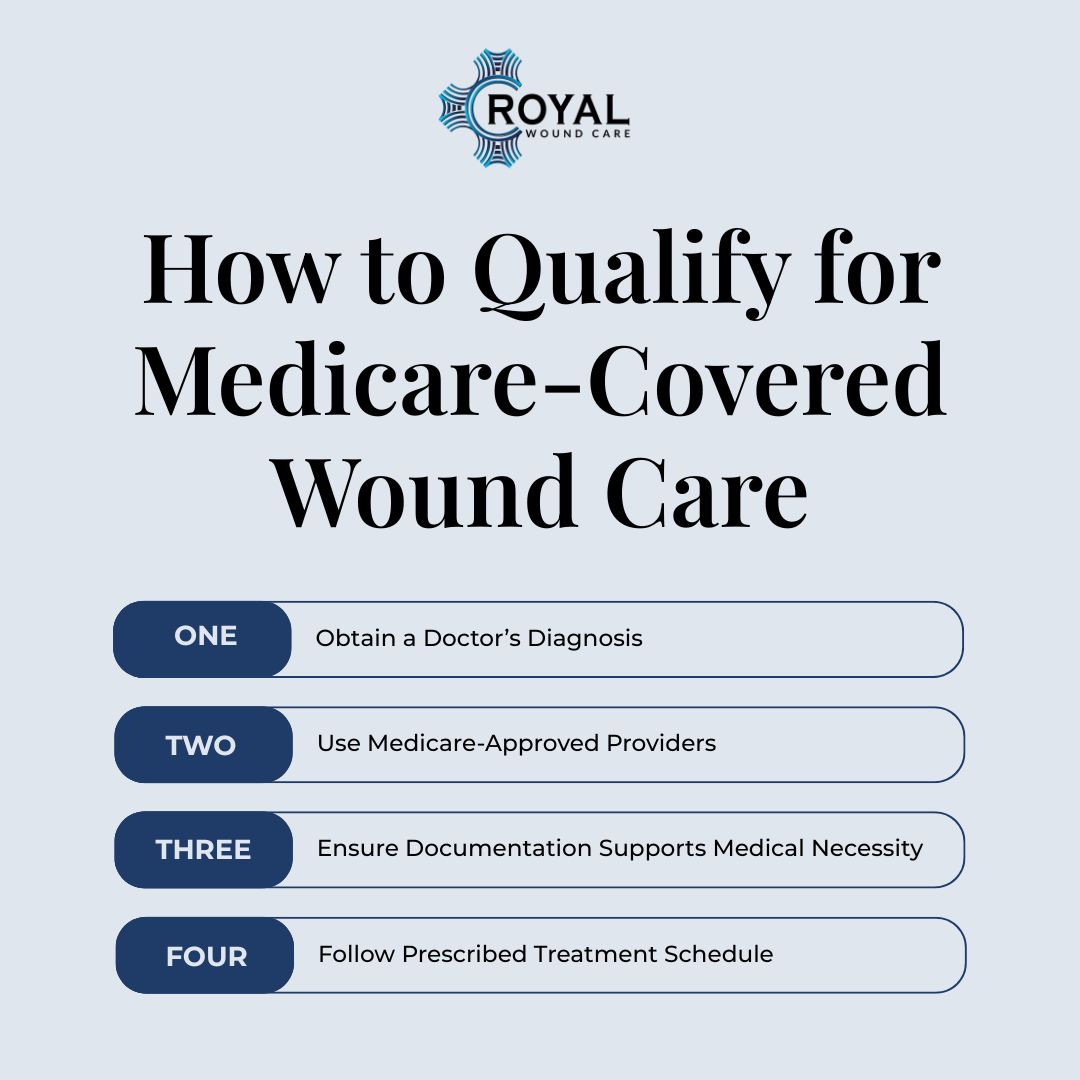
How to Qualify for Medicare-Covered Wound Care
Although Medicare generally covers a variety of wound care services, patients must still meet requirements. Knowing this in advance can save you stress, time, and unexpected costs later on.
Obtain a Doctor’s Diagnosis
The first step to receiving Medicare coverage is obtaining a formal diagnosis and treatment plan from a qualified healthcare professional. This is non-negotiable, as Medicare only covers care when the wound results from a diagnosable condition. Beyond this, thorough documentation also provides the diagnosis, recommended treatments, expected goals, and medical necessity. Without proper documentation, Medicare may inevitably deny coverage.
Related: What Does it Mean to be Board-Certified in Wound Care?
Use Medicare-Approved Providers
Choosing providers who participate in Medicare is another important step. Medicare-approved providers understand coverage requirements, documentation standards, and billing procedures. As a result, patients can feel more confident that they won’t be hit with unexpected out-of-pocket costs or denied care. Before beginning treatment, it’s important to verify your provider accepts Medicare and is authorized to provide necessary care.
Ensure Documentation Supports Medical Necessity
Medical necessity plays a significant role in determining coverage for wound care. Providers must document why patients need treatment, how the wound is responding to care, and why continued services are appropriate. This documentation helps demonstrate that treatment is necessary rather than optional or purely preventative. Think of it this way: the stronger the documentation, the easier it is to support Medicare coverage decisions.
Related: A Nurse’s Step-by-Step Checklist
Follow Prescribed Treatment Schedule
Prescribed treatment plans ensure patients heal as quickly and safely as possible. However, beyond this, Medicare only covers treatments, services, and equipment that are reasonable and medically necessary. Missed appointments, inconsistent treatment, or failure to follow provider recommendations can ultimately create documentation challenges that threaten coverage. To avoid this, ensure you attend scheduled visits and actively participate in care instructions.
Understanding your Medicare benefits for wound care can help you better prepare for future treatment.
For many patients, wound care can be stressful, overwhelming, and intimidating. Add unexpected costs and navigating Medicare, and it’s understandable why many aren’t sure where to begin—or whether to seek care at all. However, by reviewing this post, you position yourself as a more confident, better-informed patient—giving yourself the tools needed to navigate both healing and insurance.
At Royal Wound Care, one of the nation’s few board-certified wound care clinics, we provide specialized services for patients throughout the greater San Fernando Valley. If you’re looking for trusted expertise, reach out to the Royal Wound Care team or schedule a visit at our West Hills office.
For SNFs and independent nurses, make sure to review our partnership opportunities and advanced educational resources. With Royal Wound Care’s leadership, you can benefit from lower facility costs, 47% faster healing, and 88% fewer wound-related rehospitalizations. Because, ultimately, the future of wound care begins with board-certified education and tailored, compassionate care.
