
Royal Wound Care is the nation’s leading provider of advanced wound care.
Royal Wound Care is a dedicated wound care center located in West Hills, California, specializing in advanced, comprehensive wound treatment. Founded by Dr. Moaddel, Royal Wound Care was born from his commitment to improve the way patients experience wound care. After witnessing the need for more compassionate, personalized care, Dr. Moaddel opened his own center to ensure that every patient receives the attention and expertise they deserve.
After witnessing the shortcomings in traditional wound care settings, Dr. Moaddel set out to create a better experience—one where patients receive the focused, attentive care they truly deserve. That vision became Royal Wound Care.

Our Mission
To deliver exceptional, accessible wound care tailored to the individual—whether in our state of-the-art clinic, at a skilled nursing facility, or in the comfort of a patient’s home. We treat the wound, but we also care for the whole person.
Why Choose Royal Wound Care?
Ongoing Education & Certification
For staff, families, and partner facilities, including wound in-services and professional training opportunities

Expert-Led Care by Board-Certified Providers
With years of hands-on experience managing chronic and complex wounds

Advanced Modalities
Including negative pressure therapy, mist ultrasound, debridement, Doppler studies, grafts, and more

Survey-Ready Documentation
That keeps facilities compliant and families informed

Truly Personalized Care Plans
Tailored to each patient’s condition, lifestyle, and healing goals

Mobile Services That Come to You
Care delivered at home, in clinics, or within partner facilities

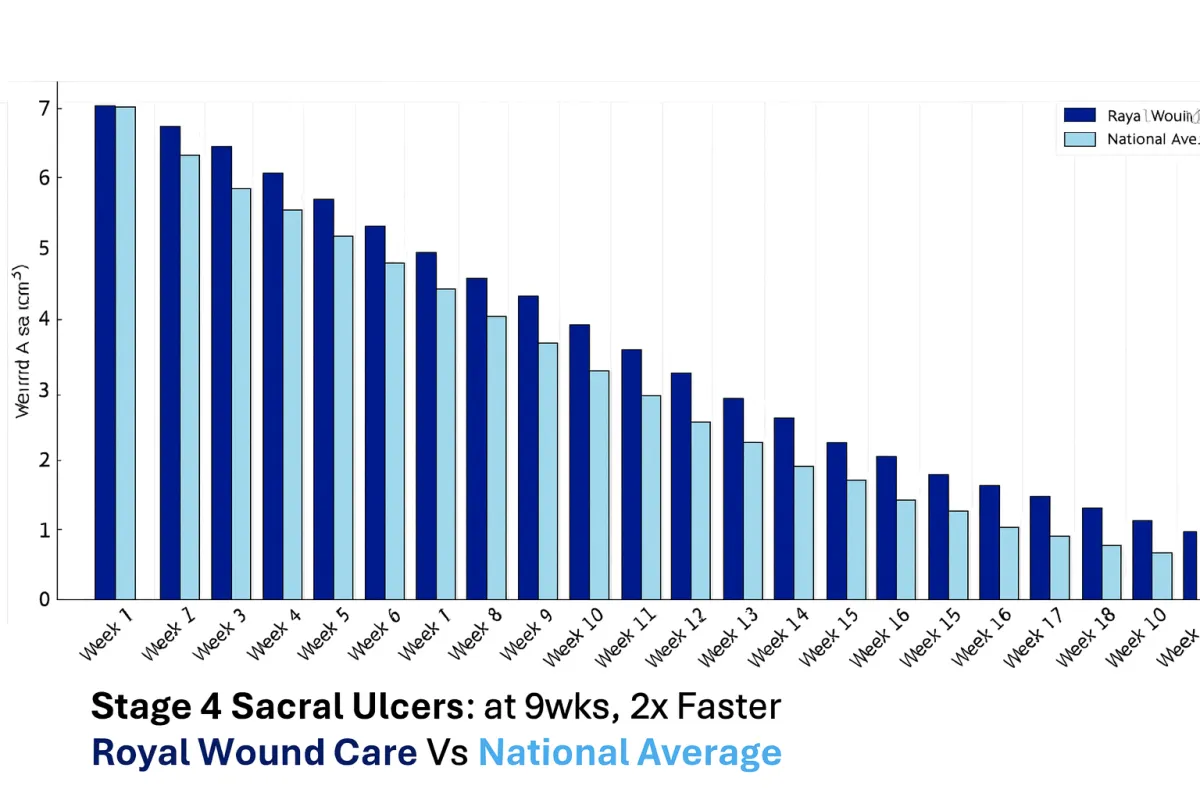
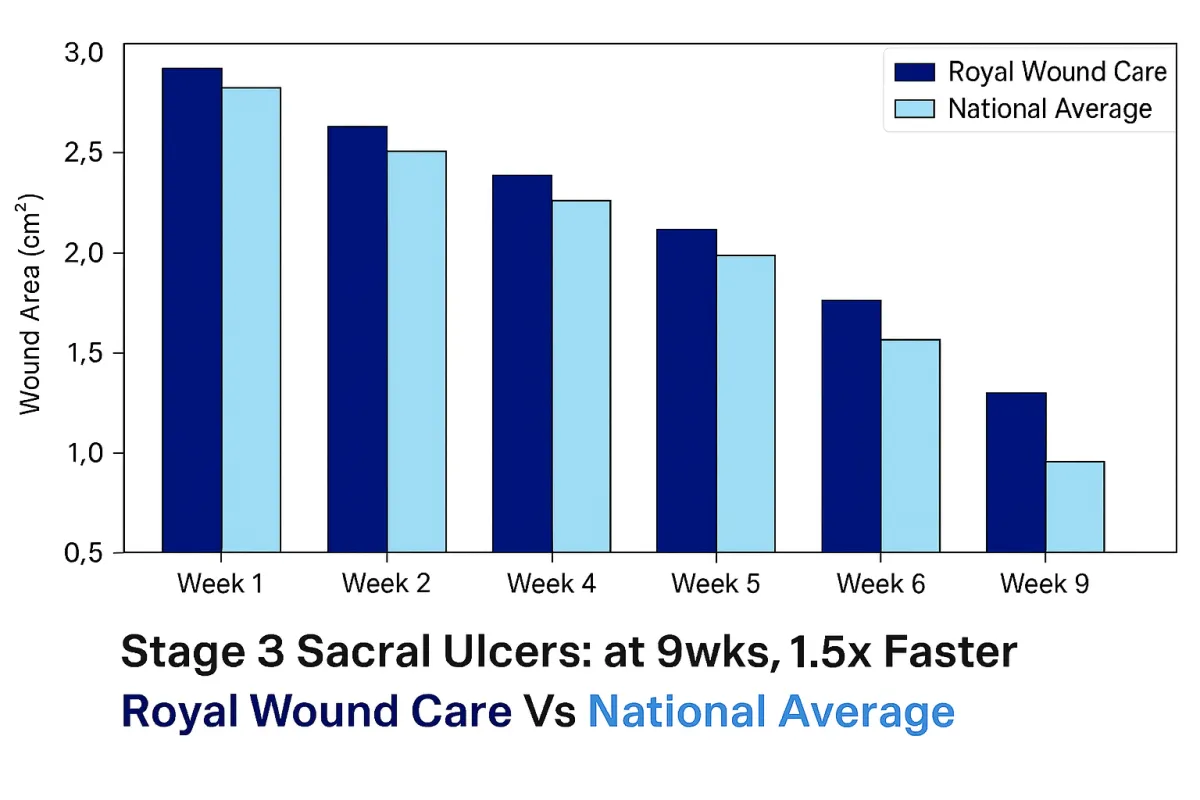
A Team That Cares And The Results To Prove It
At Royal Wound Care, we deliver results that consistently outperform the national average. Our advanced healing process combines evidence-based treatments, personalized care plans, and direct physician oversight to ensure optimal outcomes. Unlike many clinics, every patient is managed by a board-certified wound care physician who evaluates their condition and customizes treatment from day one.
Our Stage 3 Sacral ulcer graph demonstrates how our approach leads to significantly faster healing compared to the national average. While traditional care results in gradual wound size reduction over several months, patients treated at Royal Wound Care experience more rapid progress through targeted therapies, aggressive infection control, and ongoing physician-directed adjustments to their care plan. Our proactive methods allow us to close even complex wounds weeks earlier than national trends, improving patient mobility, reducing pain, and preventing further complications.
Stage 4 sacral ulcers are among the most complex wounds to treat, yet our outcomes set us apart. Patients at Royal Wound Care heal twice as fast as the national average by leveraging advanced biologic grafts, comprehensive infection management, and customized care protocols. These results highlight our proactive, physician-led care model, allowing us to manage even the most challenging cases successfully while improving long-term patient outcomes.
What Our Partners Experience
86% lower infection rates

47% faster healing compared to others

88% fewer wound-related rehospitalizations

58% faster pressure ulcer healing times

Ready to Heal with Royal Wound Care?
How Do You Become a Certified Wound Care Nurse?
How Do You Become a Certified Wound Care Nurse?
Becoming a certified wound care nurse is an honorable achievement for those in the medical field. From removing gauze stuck to wounds to treating complex diabetic foot ulcers, the role encompasses tending to a wide range of conditions across care settings. However, wound care nursing isn’t necessarily about adding credentials to a resume.
Instead, it’s about gaining specialized expertise in assessing, managing, and treating diverse injuries. Naturally, of course, wound care certifications enhance professional credibility and lead to better job opportunities. However, they also strengthen clinical judgment, improve patient outcomes, and prevent life-threatening complications.
At Royal Wound Care, compassionate, personalized care is the cornerstone of our mission—one supported by ongoing education and expert-led treatment. That’s why today, we’re discussing how to become a certified wound care nurse—step-by-step—so you can move forward with confidence.

How Do You Become a Certified Wound Care Nurse?
Many nurses aspire to specialize in wound care, yet find the certification process confusing. With multiple certifying organizations, unique requirements, and different certification pathways, it’s easy to become unsure or overwhelmed.
Each accrediting institution offers a different focus. Some prioritize general skin and wound management (WCC, WCT) while others offer specialized education in advanced knowledge and skills. This guide serves as a way to simplify the process. First, we’ll discuss what a certified wound care nurse is and what their responsibilities entail.
After that, we will review different wound care nurse certification requirements and explore the step-by-step procedure for becoming a certified wound care nurse. This information is essential for choosing a path that aligns with your career goals.
For additional information, we encourage you to read “Wound Care Training for Nurses” next.
What Is a Certified Wound Care Nurse?
A Certified Wound Care Nurse (CWCN) is a registered nurse who has completed specialty education, training, and certification. Moreover, they have passed a formal exam demonstrating advanced knowledge and skills in wound assessment, treatment planning, and wound healing management.
A Certified Wound Care Nurse’s role is much different from that of a general nurse position. CWCNs enroll in specialized training and education to gain knowledge that general nurses don’t necessarily need. Additionally, general nurses often treat simple lacerations or abrasions. Certified wound care specialists, on the other hand, manage complex cases, including ulcers, infections, chronic wounds, and severe burns.
Because Certified Wound Care Nurses often work in specialized facilities, their core responsibilities vary significantly. Unlike general nurses, CWCNs evaluate injuries, perform debridement, apply dressings, educate patients about the recovery process, and create comprehensive, personalized healing plans.
They often do so alongside multidisciplinary teams, including physicians, nurse practitioners, and physical therapists. Ultimately, this level of expertise and commitment is vital for guiding treatment decisions and supporting optimal healing outcomes.
What Does a Wound Care Nurse Do?
Responsibilities for wound care nurses vary by speciality, area of expertise, and workplace. However, nurses specializing in wound care commonly:
Assess and monitor patient wounds and healing progress.
Develop individualized wound treatment plans and implement therapies.
Perform wound debridement, dressing changes, and pain management.
Educate patients and caregivers on wound care best practices and prevention.
Collaborate with physicians and healthcare teams to adjust care plans.

Wound Care Nurse Certification Requirements
Several organizations offer unique certification pathways. Below, we will provide an overview of each program as well as a breakdown of eligibility requirements:
Wound, Ostomy, and Continence Nursing Certification Board (WOCNCB)
The Wound, Ostomy, and Continence Nursing Certification Board is a not-for-profit organization that provides rigorous expertise and encourages continued education. Known as one of the most widely recognized credentialing organizations, nurses who attend gain specialized expertise in wound, ostomy, and continence care.
In fact, patients with chronic wounds who receive care from certified WOC nurses experience a 78.5% healing rate. This is incredible considering that care from general nurses results in approximately 36.3% healing.
WOCNCB certification requirements include:
Current RN licensure
A bachelor’s degree or higher
Completion of an accredited Wound, Ostomy, and Continence Nursing Education Program within the last 5 years
50 contact hours in the specialty over the previous 5 years
1,500 hours of clinical experience in the specialty within the past 5 years or 375 hours in the last year
Requirements vary depending on the nurse practitioner’s desired pathway. Additionally, a WOCNCB certification provides formal recognition, an enhanced professional network, and improved patient outcomes.
American Nurses Credentialing Center (ANCC)
The American Nurses Credentialing Center is the largest national organization offering certification for nurses pursuing speciality practices and advanced roles. The ANCC certification is not specific to wound care management.
Instead, it’s considered the “gold standard” in nursing, demonstrating that a nurse has expert-level knowledge beyond general RN competence. This certification is highly effective in separating general nurses from specialists in the field.
ANCC certification requirements include:
An active RN licensure
A bachelor's degree (or higher)
Practice as an RN for at least 2 years
30 hours of continuing education related to your chosen specialty in the previous 3 years
Passing a 150-question multiple-choice exam
Nurses with ANCC certification often receive higher pay, increased promotions, and specialized roles. Moreover, this dedication qualifies many nurses for Magnet hospital positions.
National Alliance of Wound Care and Ostomy (NAWCO)
The National Alliance of Wound Care and Ostomy is a non-profit organization that certifies wound and ostomy professionals. Their mission is to establish and maintain guidelines for excellence in wound care management, ensuring patients receive treatment in accordance with expert practices.
NAWCO certifications are not limited to nurses; therapists, physicians, and clinicians can also enroll and become certified. Additionally, NAWCO administers the Wound Care Certified (WCC) and Diabetic Wound Care (DWC) examinations. These multidisciplinary certifications enhance expertise and demonstrate true professional credibility.
NAWCO certification requirements include:
An active, unrestricted license in an approved profession
Completion of the NAWCO-approved Skin and Wound Management education course
One of the following: 120 hours of hands-on clinical training with NAWCO preceptor, 2 full-time years (or 4 part-time years) experience in wound care, management, or research within the previous 5 years
Passing the 110-question multiple-choice WCC exam
Similar to previous certifications, NAWCO enhances career growth and improves patient outcomes. Certified nurses can then have the freedom to work in hospitals, long-term care facilities, or in home health care settings.
Wound Care Nurse Certification (WCN-C)
Offered by Royal Wound Care, the Wound Care Nurse Certification is a premier training program for furthering education. The course framework is designed to meet basic educational needs for those working in various clinical settings. Moreover, it provides a comprehensive review of what licensed nurses in the field of wound care can expect.
WCN-C course objectives include:
Anatomy and physiology of the skin
Phases of wound healing
Fundamentals of wound care
Classification, identification, and management of different wounds
Overview of how to use wound care dressings
Types, properties, and uses of wound debridement
The role of wound care nurses including assessment, documentation, infection control, consultation, and monitoring
Hands-on skills lab discussing advanced wound treatments, such as Negative Pressure Wound Therapy (NPWT), compression therapy, circulation assessment using a Doppler, and aseptic dressing change techniques
This 8-hour program can be taken online or in person. However, online participants must complete the hands-on skill lab with a qualified preceptor.
Related: Wound Nurse Certification Programs

How to Become a Certified Wound Care Nurse
Step 1: Earn Your RN Licensure
Before you can become certified in wound care, you must earn a nursing degree. An Associate’s Degree in Nursing (ADN) is acceptable, but many organizations prefer a Bachelor’s Degree (BSN). Education is the first and most crucial step toward gaining a comprehensive foundation in leadership, research, skills, and evidence-based practices.
Following graduation, nurses must then pass the National Council Licensure Examination for Registered Nurses (NCLEX-RN). Doing so ensures that nurses are legally able to practice as RNs.
Step 2: Gain Clinical Experience
For those wanting to join a wound care team and specialize in the field, clinical experience is essential. Many reputable certification organizations (such as WCC or WOCNB) require nurses to have 1–3 years of clinical experience.
Additionally, clinical experience sharpens critical thinking, enhances decision-making, demonstrates hands-on competence, and provides a thorough understanding of the realities of wound care. Many wound care nurses suggest working in home health agencies, long-term care facilities, or wound clinics to accumulate hours.
Step 3: Complete Wound Care Education
Before applying for certification, make sure you enroll in accredited wound care training programs. Similar to clinical experience, many programs have specific (and strict) eligibility requirements.
These education programs may include classroom, online, or hybrid formats. Additionally, they often cover topics such as skin assessment, wound etiology, infection control, nutrition, and treatment of complex wounds.
For more context, visit our guide: “Wound Healing and Nutrition: What to Eat for Faster Wound Healing.”
Step 4: Apply for Certification
After gaining experience and completing wound care education, apply for the appropriate certification. To start, submit documentation including RN license, clinical hours, education certificates, and any necessary application fees.
Review the certification opportunities mentioned above for additional information throughout this process. Some notable options include certifications such as WOCNCB, NAWCO, and ABWM.
Step 5: Pass the Certification Exam
After completing your certification program, prepare for and take the official certification exam. Many nurses prioritize materials such as review courses, practice questions, workbooks, and structured study plans. This is vital for strengthening confidence and performance.
Additionally, some certification courses offer short preparation resources, high pass rates, and on-demand training. Ensure you use what’s available to maintain up-to-date knowledge.
Step 6: Maintain and Renew Certification
Most wound care certifications require renewal every few years. This may include continuing education, clinical practice hours, or retesting to ensure ongoing competency. Keep an eye on the necessary retest dates to maintain active status. Failure to renew may result in the revocation of credentials and overall retesting of knowledge.
Become a certified wound care nurse through clinical experience, proper education, and necessary certifications.
Becoming a certified wound care nurse is a meaningful step for nurse practitioners passionate about improving patient outcomes and increasing access to treatment. With the right education, experience, and certification pathways, you can play a vital role in healing while simultaneously advancing your career.
The highly-trained team at Royal Wound Care guarantees expert-led care and personalized treatment plans. From in-clinic wound care services to mobile wound care, we strive to meet patients wherever they are in their healing journey. Contact the Royal Wound Care team today to learn more!
Additionally, we offer extensive educational opportunities and professional partnerships to SNFs and independent nurses looking to enhance their skillsets! From faster healing times to lower infection rates, learn why partnering with Royal Wound Care is exactly what your career needs.

WEST HILLS
7230 Medical Center Dr. Suite 100
West Hills, CA 91307
(818)–660–2977
BEVERLY HILLS
9735 Wilshare Blvd #210B
Beverly Hills, CA 90212
(818)–660–2977
Request an Appointment at a Royal Wound Care Facility near you.
Royal Wound Care is the expert in wound healing. Our board-certified wound care specialists are ready to help you begin your healing journey. Click the button below to request an appointment at a Wound Care Center near you—no referral needed
© 2025 Royal Wound Care, LLC. All rights reserved.
site by Growth Partners Marketing