How to Become a Wound Care Nurse: Steps, Timeline, and Requirements
How to Become a Wound Care Nurse: Steps, Timeline, and Requirements
If you're a nurse who finds yourself more interested in those patients other units find complicated, the ones who have a diabetic foot ulcer that just won't heal or a pressure injury that keeps coming back, wound care might be the specialty you've been waiting for. This specialization combines hands-on patient care with a focus on assessing, preventing, treating, and managing wounds, and it appeals to nurses who enjoy a clinical challenge.
Many nurses choose this specialty because they genuinely want to see their patients' wounds heal. Because chronic wounds can be encountered in hospitals, long-term care, home health, and outpatient clinics, these skill sets are needed in virtually all health care environments.
At Royal Wound Care, Dr. Moaddel and our board certified team regularly treat chronic and non-healing wounds across the San Fernando Valley from our clinic in West Hills, where skilled wound nursing is central to improving healing times and reducing complications.
Our Wound Care Nurse Certification course helps licensed nurses develop the expertise this work requires. Below, we'll outline the steps to becoming a wound care nurse, how long it will take to qualify, and the criteria for doing so, since the right path depends on whether you start as an LPN/LVN or an RN and which credential you're working toward.
How to Become a Wound Care Nurse
To become a wound care nurse, you must first become a licensed nurse, usually a registered nurse (RN), although some credentials are available to licensed practical nurses (LPNs) and licensed vocational nurses (LVNs). Then, you need to gain experience caring for wound patients, complete wound care training, and pass a board exam to earn a wound care certification.
There are several different certifications and credentials that wound care nurses may hold, and the license you start with shapes which ones you can earn.
What Does a Wound Care Nurse Do?
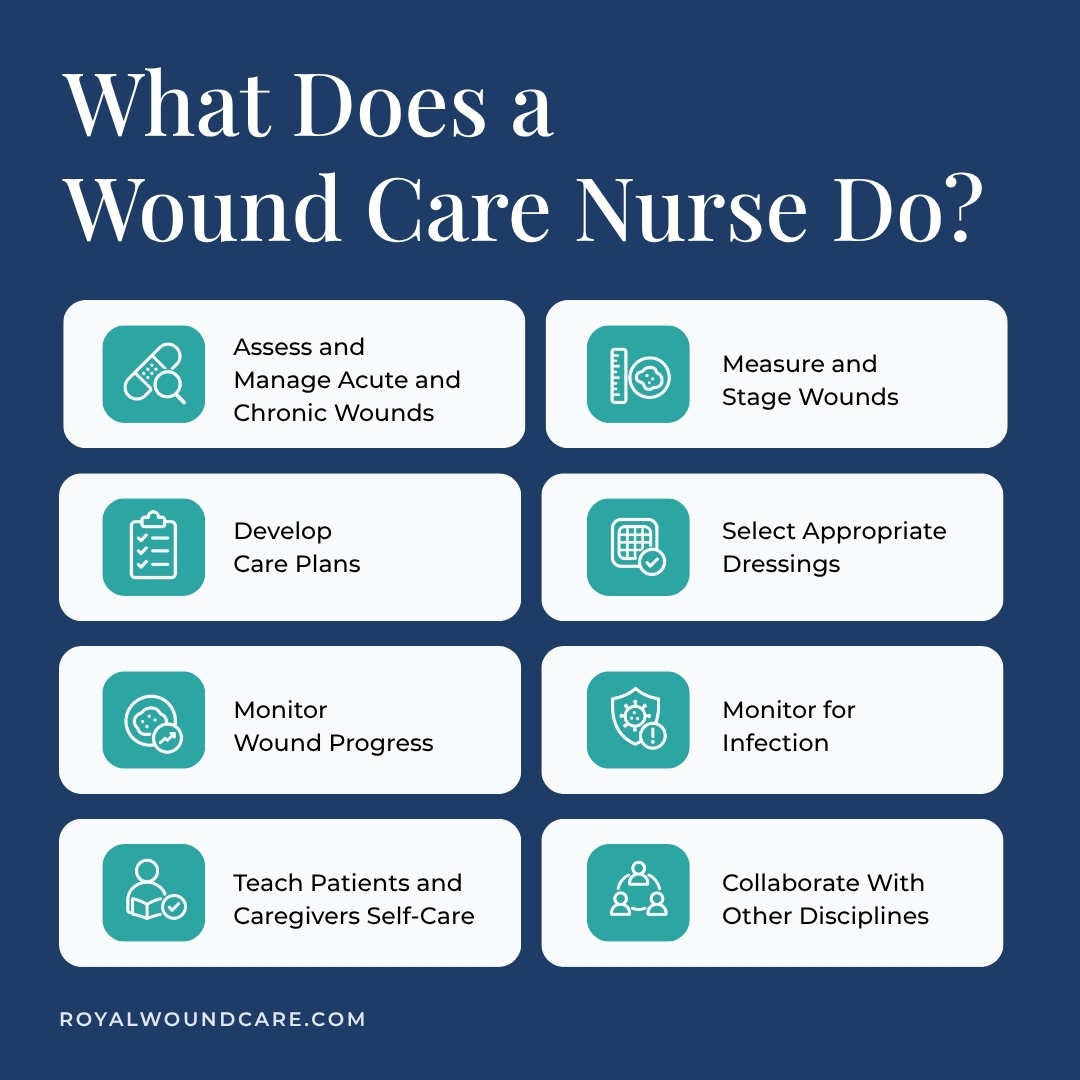
A wound care nurse assesses and manages both acute and chronic wounds, develops care plans, monitors wound progress, and instructs patients and caregivers in self-care techniques. The work involves a high degree of attention to detail: wound measurement, staging, appropriate dressing selection, monitoring for infection, and collaborating with other disciplines.
Wound care nurses practice in hospitals, long-term care facilities, skilled nursing facilities, home health, and outpatient wound clinics. In many of these settings, the position has a direct connection to quality metrics and reimbursement, which is one of the reasons it's sought after.
WOCNCB credentials are listed in the ANCC's Demographic Data Collection Tool, which Magnet-designated and Magnet-seeking hospitals use to report their nurses' certifications.
[NEEDS SOURCE: EEAT, no material in MCD Section 8]
From Nursing School to Wound Care Specialist
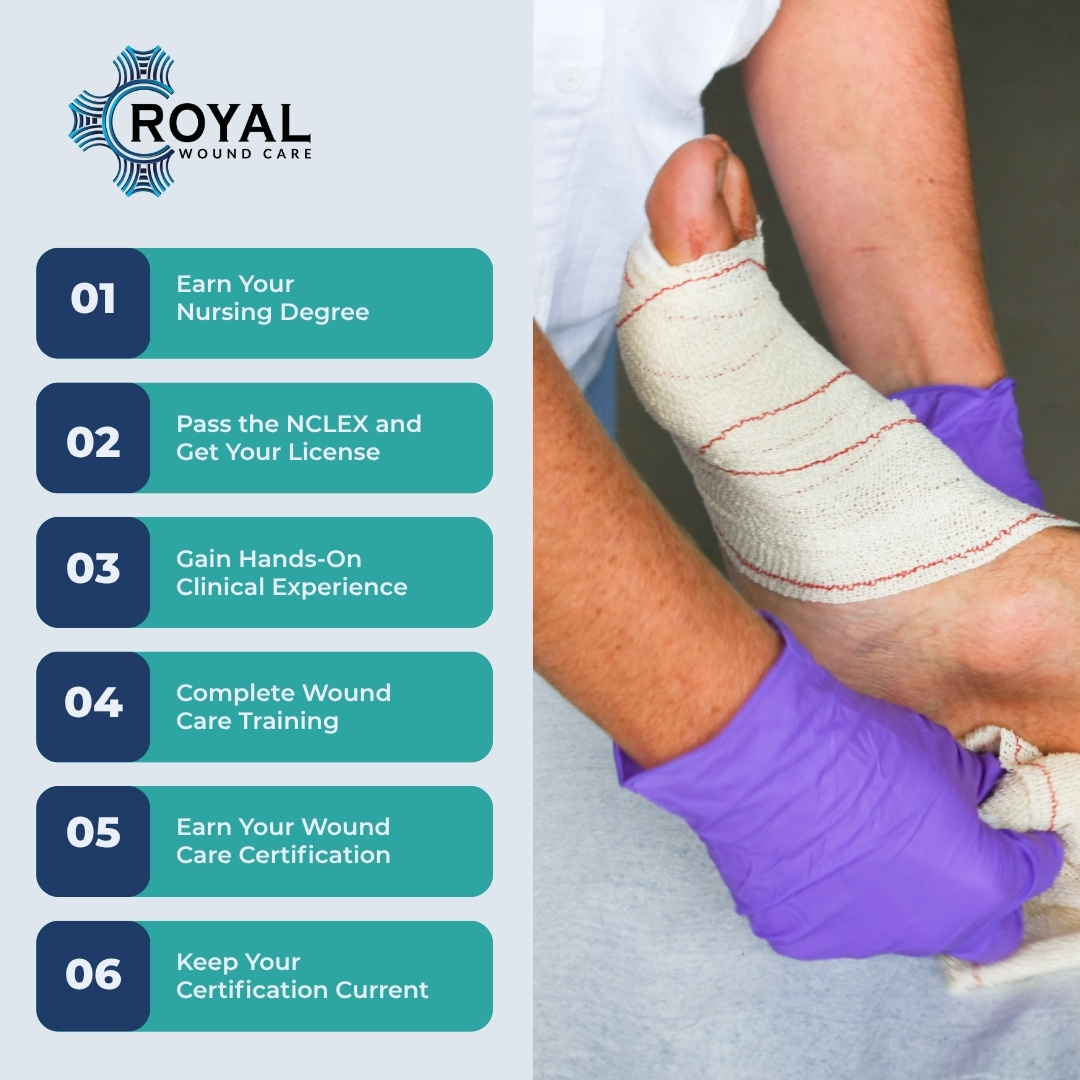
There's no shortcut into wound care nursing, but the path is simple and linear. It starts with nursing school and licensure, followed by some clinical experience, specialized education, and a board exam that aligns with your license and career objectives. Each step below explains what it involves and why it matters.
Step One: Earn Your Nursing Degree
A nursing degree is required for wound care nurses. Most wound care nurses will pursue an Associate Degree in Nursing (ADN) or Bachelor of Science in Nursing (BSN) to become a registered nurse, but others may begin their careers as licensed practical/vocational nurses (LPN/LVN).
Your degree choice now will determine your certification eligibility in the future. While several wound care certifications are available to LPNs and LVNs, only nurses with a bachelor's degree will qualify for the most advanced nursing certifications.
All WOCNCB credentials require RN licensure, a bachelor's degree or higher, and recertification every five years. Conversely, NAWCO's Wound Care Certified (WCC) credential is open to LPNs, physical therapists, and physicians, among other clinicians. If you've earned an ADN and plan to pursue RN-only credentials, an RN-to-BSN program is the logical progression.
Step Two: Pass the Nclex and Get Your License
Once you graduate from nursing school, you'll take the NCLEX-RN or NCLEX-PN (depending on your program) and apply for your state license. Licensure is the entry level requirement for every wound care nursing role: no license, no clinical practice, and no certification.
Passing the NCLEX establishes your ability to work safely as a nurse, which all wound care certifications require. Keeping your license active and unrestricted is also necessary for earning and maintaining wound care certification.
Step Three: Gain Hands-on Clinical Experience
Wound care certification exams assess your ability to make decisions based on your clinical experience. The settings where you're most likely to encounter relevant cases include med/surg and surgical units, long-term care and skilled nursing facilities, home health, and wound care clinics. You'll gain exposure to diabetic foot ulcers, pressure ulcers, venous ulcers, and arterial ulcers in these settings. To get that exposure early, you could volunteer to participate in wound rounds and ask to shadow a certified wound nurse on your unit.
Most certification boards require documented experience before you can sit for the exam, and specific requirements vary by organization. To qualify for the CWOCN credential via the experiential route, you need 1,500 hours of direct patient care in each specialty (with at least 375 hours occurring in the last year), along with 50 continuing education hours per specialty, all within the last five years.
For ABWM certifications such as the CWS, you must have at least three years of wound care experience. This time doesn't have to be your sole focus, and the years don't need to be consecutive, as long as they add up to three cumulative years. Because these requirements change from time to time, make sure you reach out to the certifying organization to verify the most up-to-date rules before you apply.
[NEEDS SOURCE: EEAT, no material in MCD Section 8]
Step Four: Complete Wound Care Training
Quality wound care training ties together wound assessment and staging, dressing selection, infection identification, debridement techniques, the role of nutrition, and the importance of documentation for care and reimbursement. Strong programs integrate theory with clinical skills, so you build the knowledge and skills you need for both the exam and the demands of the work itself.
For many nurses, it's also the most efficient way to bridge the gap between clinical experience and what the exams expect, and for some credentials, training is a formal requirement: the WCC, for example, requires a NAWCO-recognized skin and wound management course. If you want to see what quality wound care training looks like, check out our guide on wound care training for nurses.
Step Five: Earn Your Wound Care Certification
Once you're eligible to apply, you'll sit for a board certification exam specific to your license type and the scope of your practice. Some of the most common certifications are the WCC (Wound Care Certified), the CWCN (Certified Wound Care Nurse), the CWOCN for wound ostomy and continence nursing, and the CWS (Certified Wound Specialist).
Earning board certification tells employers that you've reached a nationally recognized standard, and it lets you demonstrate that you can practice at a higher level. We go into detail about each of these certifications in our article on wound care certification for RNs, which should help you weigh your options and decide which certification is right for you. When you're ready to prepare, our wound care nurse certification course covers the clinical knowledge behind these exams.
Step Six: Keep Your Certification Current
Becoming certified isn't a one-and-done process. Most wound care certifications follow a renewal timeline and require continuing education to maintain your certification. For example, WOCNCB certifications expire after five years, and recertifying means either retaking the exam or completing the Professional Growth Program, a portfolio of at least 80 points with at least half of those in the certified specialty.
The ABWM's CWS has a different recertification schedule, because the Certified Wound Specialist credential is valid for ten years, with annual renewals and continuing education in between.
Keeping your certification current helps your knowledge and skills stay sharp as standards continue to improve. It also protects your professional status as a board certified nurse, something that employers and facilities value highly. Our certification program includes CEUs and re-certification support to help you stay up to date.
How Long to Become a Wound Care Nurse
The timeline depends largely on where you're starting, but the steps are fairly predictable. You'll begin with nursing school, pass your licensing exam, gain clinical experience based on the requirements of the certification you choose, undergo specialized training, and finally take the exam. In reality, most nurses can expect to earn wound care certification three to seven years after beginning nursing school, depending on their degree path and chosen credential.
Faster ways: start your nursing career in a wound care-heavy facility so your wound care hours build up quickly, and select a credential that aligns with the wound care experience you already have. Slower ways: needing to complete an RN-to-BSN bridge program, or pursuing a credential that requires three cumulative years of wound care experience (for example, CWS).
Stage | Typical time |
Nursing education (LPN/LVN) | About 1 year |
Nursing education (ADN) | About 2 years |
Nursing education (BSN) | About 4 years |
NCLEX and state licensure | Weeks to a few months |
Clinical wound experience | 1 to 3+ years, depending on the credential |
Wound care training and certification | A few months |
What Is Needed to Become a Wound Care Nurse
Here's the short list, separated into the basic nursing requirements and the wound care specific ones. The wound care items vary depending on the pathway and credential you choose, so make sure to double check the current rules with the certifying board. For a detailed step-by-step guide specifically regarding the credential process, please see our article on how to become a certified wound care nurse.
Basic Nursing Requirements
A nursing degree: an LPN/LVN program, or an ADN or BSN for RN licensure
A passing score on the NCLEX-PN or NCLEX-RN
An active, unrestricted nursing license in your state
Documented hands-on clinical experience with wound patients
Wound Care Specific Requirements
Specialized wound care training that gives you exam-level knowledge and skills
A board certification based on your license (for example, the WCC credential, which is open to RNs, LPNs/LVNs, PTs, OTs, and other licensed health care providers who provide direct wound care, or an RN-only WOCNCB credential such as the CWCN or CWOCN)
The clinical hours or years of experience required for the credential you choose
Continuing education to maintain your certification
If you're a nurse or clinical team in the San Fernando Valley, from West Hills and Woodland Hills to Canoga Park and Chatsworth, looking for your next step, our Wound Care Nurse Certification course offers nationally recognized training, CEUs, and hands-on skill-building taught by a board-certified wound care team. It includes 8 contact hours of continuing education approved by the California Board of Registered Nursing. The course is self-paced, so you can enroll in the Wound Care Nurse Certification course and start anytime.
Written by Dr. Moaddel, Royal Wound Care
The information in this article is intended for educational purposes only and should not be used as a substitute for professional medical evaluation or individualized career and licensing advice. Eligibility requirements for wound care certifications may change. Please contact the respective certifying board directly to ensure that you meet the requirements for your certification.
